Walk through any North American hardware store parking lot on a Saturday morning, and you will see them: small utility trailers hitched to midsize SUVs and compact pickups, loaded with lumber, landscaping supplies, or camping gear. These trailers rarely make headlines, yet collectively they represent a 2.08billionglobalmarketin2026—growingsteadilytoward2.76 billion by 2034 at a 3.6% compound annual rate, according to Fortune Business Insights.
For axle and brake component suppliers, this quiet growth carries significant implications. Light-duty trailers demand a fundamentally different component profile than the heavy equipment haulers and commercial flatbeds that traditionally dominate the trailer parts aftermarket. They use smaller axles, simpler brake configurations, lighter materials, and tighter price points. A supplier who understands this shift and adapts its product lineup accordingly captures a growing and resilient market segment.
At Weifang Top Trailer Accessories, we see these demand patterns reflected in our order books every quarter. This article examines four forces driving the light-duty trailer boom, what the shift means for axle and brake specifications, and how suppliers can position themselves to serve this expanding market.
The Numbers: How Big Is the Light-Duty Trailer Market?
The global light car trailer market — covering utility trailers, enclosed cargo trailers, recreational trailers, boat trailers, and specialty formats with gross vehicle weight ratings typically under 3,500 kg (7,700 lbs) — reached an estimated 1.99billionin2025andprojectsto2.76 billion by 2034.
Several supporting data points reinforce the trend:
- The teardrop camper trailer market alone reached 1.82billionin2025andprojectsto3.47 billion by 2034, growing at a 7.4% CAGR — faster than the broader light trailer market and indicative of strong recreational demand.
- The global trailer axle market will grow from 8.8billionin2025to12.4 billion by 2032 at a 5.1% CAGR, with light-duty axles accounting for a growing share of that total.
- North America dominates light-duty trailer sales with a 49.24% market share ($0.98 billion in 2025), driven by high pickup and SUV ownership, dense dealer networks, and a strong DIY and outdoor recreation culture.
- Recreational trailers represent the fastest-growing subsegment at a 5.2% CAGR through 2034 — outpacing utility trailers and commercial formats.
- Single-axle configurations dominate the light-duty market because they deliver sufficient capacity for household and light commercial loads at lower cost and weight, making them accessible to a wider range of tow vehicles.
These numbers tell a clear story: more consumers and small businesses are buying smaller, lighter trailers, and those trailers need axles and brakes sized appropriately for their weight class.
Four Forces Driving the Light-Duty Trailer Boom
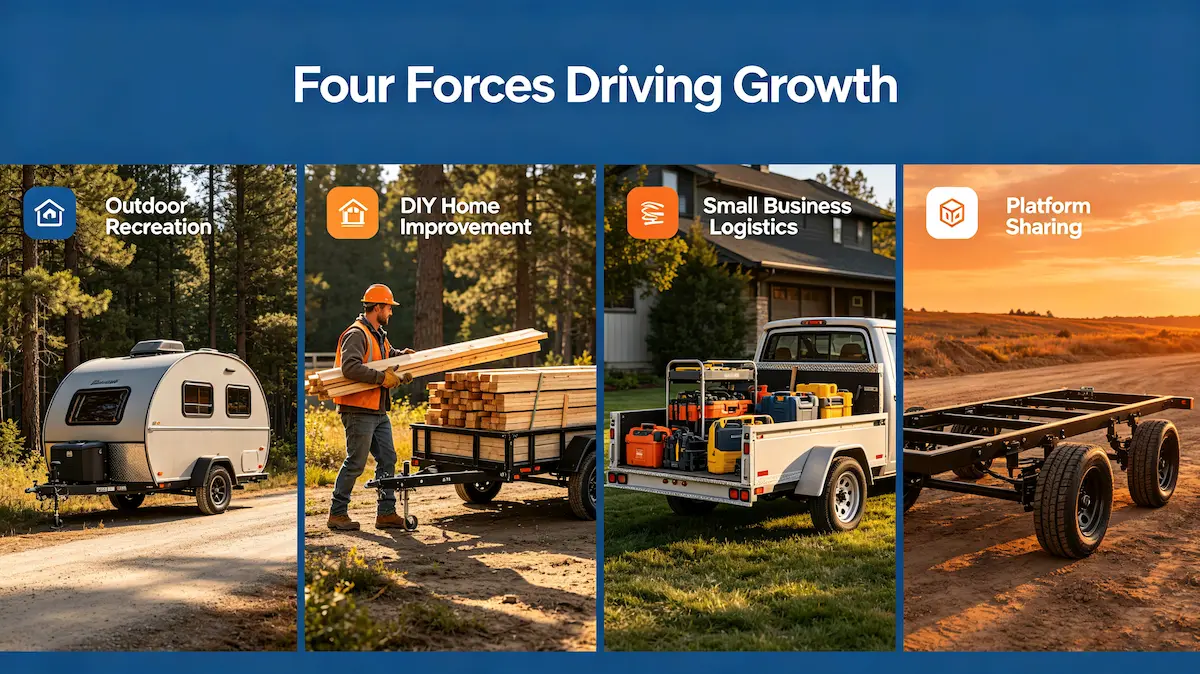
The growth is not random. Four structural shifts in how people live, work, and spend their leisure time are expanding the addressable market for light-duty trailers.
1. The Outdoor Recreation and Overlanding Surge
RV shipments in the United States reached 342,220 units in 2025 — up 2.5% year-over-year — and a growing share of those units are towable rather than motorized. Teardrop campers, small travel trailers, and off-road overlanding trailers dominate the entry-level market precisely because they pair with the midsize SUVs and crossovers that consumers already own.
Every teardrop camper and small off-road trailer needs at least one axle — typically a 2,000 to 3,500 lb unit — plus either electric brakes or a surge brake system. The recreational segment’s 5.2% CAGR means hundreds of thousands of additional axle and brake units per year by the end of the decade.
2. The DIY Economy and Home Improvement Boom
The pandemic-era surge in home improvement spending has cooled from its 2021 peak, but it left behind a permanently larger base of homeowners who own tools, tackle projects, and haul their own materials. A 5-by-8-foot utility trailer behind a midsize SUV replaces the need for delivery fees on every lumber run, appliance purchase, and landscaping project.
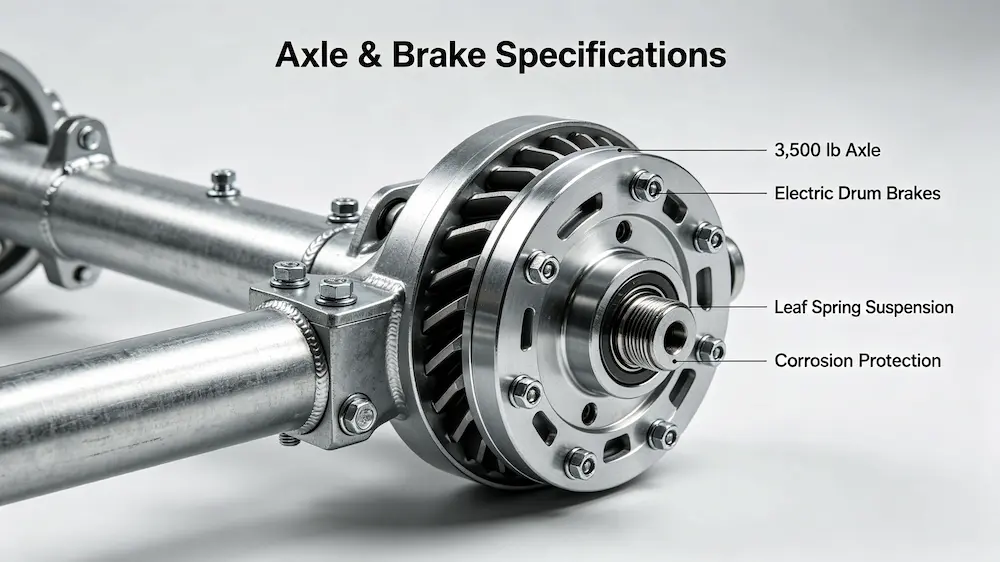
Utility trailers remain the largest single light-duty trailer segment by volume. They use simple, cost-effective running gear — typically straight axles with leaf springs and electric drum brakes rated for 2,000 to 3,500 lbs. Stable, predictable demand from this segment provides a reliable baseline for component suppliers.
3. Small Business Adoption and Last-Mile Logistics
Landscapers, maintenance contractors, mobile detailers, and small-scale delivery operators increasingly use light-duty trailers as a cost-effective alternative to a dedicated commercial vehicle. A $2,500 utility trailer behind an existing pickup costs a fraction of a second work truck and serves the same purpose for many small businesses.
The commercial use segment within light-duty trailers projects a 4.2% CAGR through 2034. Commercial users put more miles on their trailers than personal users, which accelerates wear on brake components and axle parts. Higher mileage means shorter replacement cycles — a tailwind for aftermarket parts demand.
4. Platform Sharing and Faster Product Cycles
Manufacturers such as Brian James Trailers, Carry-On, and Indespension increasingly build multiple trailer models on shared chassis platforms. One core axle, frame, and coupler platform supports utility, enclosed, and recreational variants through modular body, ramp, and rail options. This approach shortens development time, improves parts commonality, and creates higher-volume production runs for standardized components.
For axle and brake suppliers, platform sharing is good news: it means larger, more consistent orders for a smaller number of axle and brake SKUs rather than many small-batch custom orders. A supplier that can deliver consistent quality at volume on 2,000 lb, 3,500 lb, and 5,200 lb axle platforms wins long-term contracts with trailer OEMs using shared-platform strategies.
What the Shift Means for Axle Suppliers
The light-duty trailer market shifts axle demand toward a specific set of specifications that differ meaningfully from the heavy-duty aftermarket.
Capacity Range: 2,000–5,200 lbs Dominates
The heavy-duty trailer market revolves around 7,000 lb, 8,000 lb, and 10,000+ lb axles for tandem and triple-axle flatbeds, car haulers, and equipment trailers. The light-duty market concentrates demand in the 2,000 to 5,200 lb range, with 3,500 lb representing the single highest-volume axle rating.
For suppliers with manufacturing flexibility, the opportunity lies in producing 2,000–5,200 lb axles at competitive cost while maintaining quality. The 3,500 lb axle is the “1/2-inch socket” of the trailer world — the most common size by far, and the one every distributor needs in stock.
Single-Axle Configurations Lead
Single-axle trailers dominate the light-duty segment because the loads rarely justify the cost, weight, and complexity of a second axle. A 3,500 lb single axle covers the vast majority of personal-use and light commercial loads — a load of mulch, a refrigerator, two dirt bikes, or a small boat.
For suppliers, this means prioritizing single-axle kits over tandem kits in the light-duty range. It also means providing complete axle assemblies — with hubs, bearings, and mounting hardware pre-installed — since DIY buyers and small trailer shops value plug-and-play convenience over bare axle beams.
Leaf Springs Still Rule, but Torsion Is Gaining
Leaf spring axles dominate the light-duty segment on cost and familiarity. However, torsion axles are gaining share — particularly in teardrop campers and recreational trailers — because of their smoother ride, lower maintenance, and independent suspension characteristics. As we discussed in our flatbed trailer axle selection guide, the choice between leaf spring and torsion depends heavily on cargo type and terrain.
Our earlier article on axle camber, toe, and tire life covers the geometry considerations that apply equally to light-duty and heavy-duty axles — correct camber matters at every weight rating.
What the Shift Means for Brake Suppliers
The light-duty trailer market also reshapes brake component demand in specific ways.
Electric Drum Brakes Remain Standard
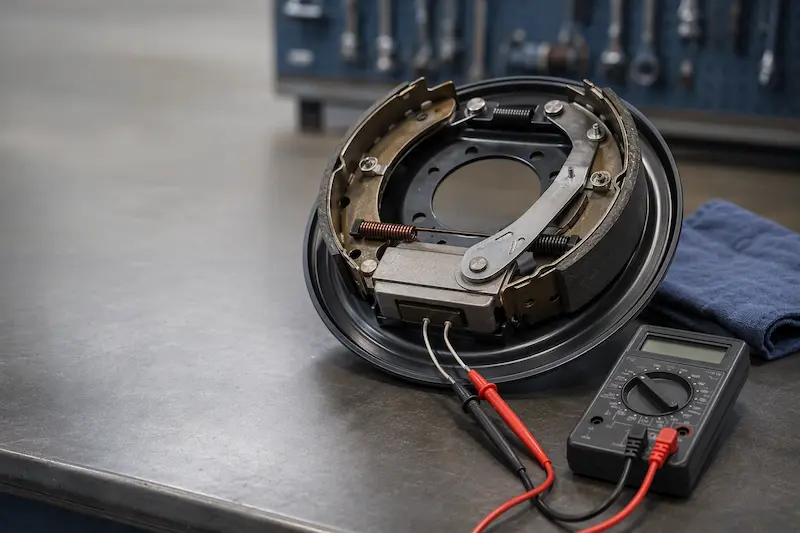
For light-duty trailers in the 2,000–3,500 lb range, electric drum brakes remain the dominant configuration. They are well understood, inexpensive to manufacture, and compatible with the brake controllers already installed in millions of pickup trucks and SUVs. The 10-inch electric brake assembly — covered in detail in our guide to brake magnet failure signs — is the workhorse of the light-duty segment.
The Tipping Point: When Brakes Become Optional
In many jurisdictions, trailers under a certain weight threshold — typically 3,000 lbs in the U.S. and 750 kg in Europe — do not legally require brakes. This creates a significant segment of the lightest-duty trailers (small jet ski trailers, 4-by-6-foot utility trailers, motorcycle carriers) that run idler axles with no brake components at all.
For brake suppliers, this means the absolute smallest trailers (under 1,500-2,000 lbs) represent a limited addressable market for brake components. The sweet spot for light-duty brake demand sits in the 2,500–3,500 lb range, where most jurisdictions require brakes and where buyers increasingly spec them even when not legally mandated, because they improve safety.
Surge Brakes for the Marine Segment
Boat trailers — a significant subsegment of the light-duty market — frequently use surge brake systems rather than electric brakes, because electric components and saltwater do not mix. Our comparison of hydraulic vs. electric brakes for boat trailers examines this trade-off in depth. Suppliers serving the light-duty marine market need surge-compatible brake components in addition to standard electric brake assemblies.
The Opportunity: Higher-Spec Brakes on Recreational Trailers
Recreational trailer buyers — teardrop campers, small travel trailers, toy haulers — tend to be more safety-conscious and less price-sensitive than utility trailer buyers. They are more likely to spec brakes on trailers that legally do not require them, and more willing to pay for proportional brake controllers, self-adjusting brakes, and higher-quality brake drums. This subsegment represents the highest-margin opportunity within the light-duty brake market.
Material and Design Implications
Light-duty trailers impose different material requirements than heavy trailers — not lower quality, but different priorities.
Corrosion Resistance Over Raw Strength
A 3,500 lb utility trailer rarely approaches the structural limits of its axle beam. What kills light-duty axles is not overload but rust. Trailers stored outdoors, used on salted winter roads, or launched at saltwater boat ramps accumulate corrosion year after year. The axle does not bend — it rusts through.
For suppliers, this means prioritizing corrosion protection on light-duty components: galvanized or powder-coated axle tubes, stainless steel hardware where practical, and sealed bearing systems that prevent water intrusion. A light-duty axle that lasts 20 years because it resists rust competes differently than one that lasts 8 years and fails from corrosion — even if both carry identical load ratings.
Weight Reduction: Every Pound Matters
Light-duty trailers hitch to vehicles with limited tow ratings. A midsize SUV rated for 3,500 lbs towing cannot tow a 1,200 lb trailer plus 2,500 lbs of cargo if the trailer itself weighs too much. Manufacturers constantly seek weight reduction in every component — including axles and brakes.
This creates demand for lighter axle designs within standard weight ratings: aluminum axle beams (still rare but growing), thinner-wall steel tubes where structurally permissible, and compact brake assemblies that shave pounds without sacrificing stopping power. A 3,500 lb axle that weighs 10% less than a competitor’s equivalent sells because it lets the trailer manufacturer advertise a higher payload capacity for the same GVWR.
Standardization Over Customization
Unlike heavy-duty axles, which often require custom spring centers, hub faces, and brake flanges for specific trailer builds, light-duty axles benefit from maximum standardization. A 3,500 lb axle with a 74-inch hub face and a 57-inch spring center fits thousands of different trailer models across dozens of manufacturers.
Suppliers that offer off-the-shelf, pre-configured light-duty axle assemblies with predictable lead times gain an advantage over those that require custom engineering for every order. Volume wins in this segment, and standardization enables volume.
The EV Towing Dimension
Electric vehicles present both a challenge and an opportunity for the light-duty trailer market.
The challenge: Towing reduces EV range by 23-31% in real-world testing, according to Arval research. Range anxiety limits how far EV owners will tow, and limited charging station pull-through access complicates charging with a trailer attached. This constrains demand for trailers among the growing EV owner base — at least in the near term.
The opportunity: EV manufacturers and trailer builders are collaborating on solutions. Lighter trailers reduce the range penalty. Aerodynamic trailer designs cut drag. And — critically for component suppliers — regenerative braking systems on EVs change how trailer brakes interact with the tow vehicle. An EV that slows primarily through regeneration demands less from the trailer brakes under normal driving, which changes the brake wear profile and may shift the optimal brake specification.
This space evolves rapidly and warrants monitoring, but the near-term impact on light-duty component demand remains limited. The vast majority of light-duty trailers sold in 2026 hitch to gasoline and diesel vehicles.
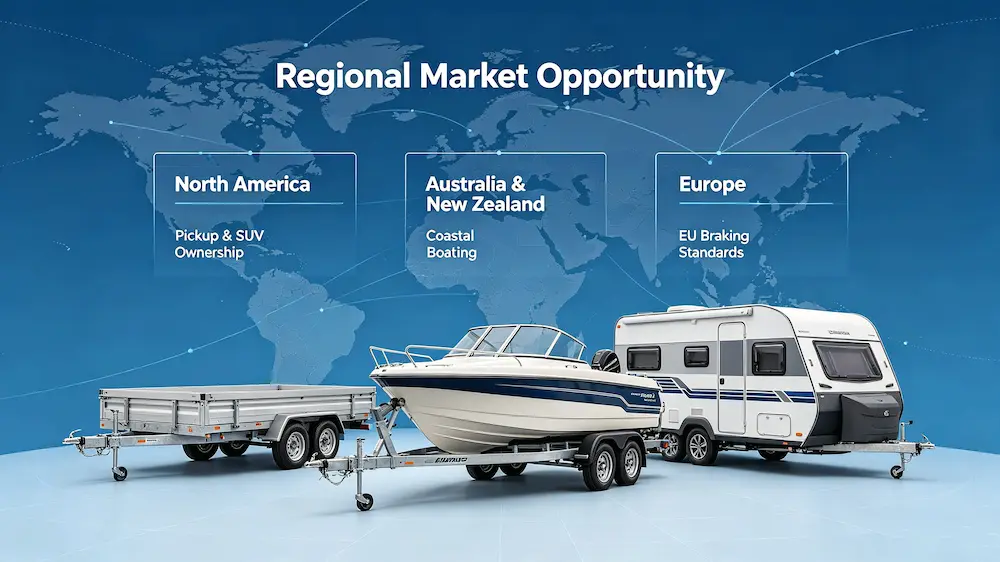
Regional Implications for Suppliers
North America
North America accounts for nearly half of global light-duty trailer sales. The U.S. alone represents roughly $0.80 billion of the market. High pickup and SUV ownership, a strong DIY culture, and widespread outdoor recreation create sustained demand for utility and recreational trailers in the 2,000–5,200 lb axle range.
For component suppliers, North America represents the largest single addressable market. Distributors and OEMs in this region demand fast fulfillment, consistent quality, and competitive pricing. Suppliers with North American warehouse inventory or short lead times from manufacturing to delivery hold a competitive advantage.
Australia and New Zealand
The Australian and New Zealand markets — key export destinations for Weifang Top — feature high trailer ownership per capita driven by boating, camping, and trades. The light-duty segment is particularly strong in boat trailers (for the region’s extensive coastline) and camping trailers (for its outdoor lifestyle).
Our guide to winter brake system storage and the jockey wheel selection guide both address considerations specific to Australian and New Zealand conditions, including coastal corrosion and mixed-terrain use.
Europe
Europe represents the second-largest regional market at an estimated $0.69 billion in 2026. European light-duty trailers face stricter type-approval and braking regulations than North American equivalents, which raises the minimum specification for brake and axle components sold into this market. Suppliers targeting European OEMs or distributors must understand EU braking directives and ensure their products carry the required certifications.
Strategic Implications for Component Buyers
If you buy axles or brakes for light-duty trailer manufacturing, distribution, or fleet maintenance, the market trends point toward several actionable conclusions:
Diversify Your 2,000–5,200 lb Inventory
The heavy end of the trailer market (7,000+ lb axles, heavy brake systems) remains important but grows more slowly than the light-duty segment. Ensure your inventory mix reflects where demand is accelerating. Stock deeper on 3,500 lb axles, 10-inch brake assemblies, and 5-lug and 6-lug hub configurations.
Prioritize Corrosion Resistance in Your Specs
End users of light-duty trailers store them outdoors, launch them at boat ramps, and tow them on winter roads. Rust, not overload, is the leading cause of premature axle and brake failure in this segment. When you evaluate suppliers, weigh corrosion protection — galvanizing, powder coating, sealed bearings — as heavily as load rating and price.
Build Relationships with Recreational OEMs
Recreational trailer manufacturers represent the fastest-growing OEM channel within the light-duty segment. These buyers value consistent quality, on-time delivery, and the ability to supply complete axle-and-brake assemblies rather than individual components. A supplier relationship with even one mid-size teardrop or small travel trailer manufacturer creates a multi-year demand stream.
Watch the EV Towing Space
While EV towing is not yet a major demand driver, it will become one over the next five to ten years. Trailers optimized for EV towing — lighter, more aerodynamic, with different brake interaction characteristics — represent a product development opportunity for forward-looking suppliers. The companies that solve EV-range-penalty problems first will capture early-mover advantage in a segment that does not yet have established component specifications.
Frequently Asked Questions (FAQ)
What qualifies as a light-duty trailer?
Industry definitions vary, but the light-duty segment generally covers trailers with a gross vehicle weight rating (GVWR) under 3,500 kg (approximately 7,700 lbs). This includes utility trailers, small enclosed cargo trailers, teardrop and small travel trailers, boat trailers for vessels under roughly 25 feet, motorcycle trailers, and specialty equipment trailers. The Fortune Business Insights light car trailer market definition specifically covers non-motorized trailers typically towed by passenger cars, SUVs, and light pickups.
Why is the light-duty segment growing faster than heavy-duty?
The growth stems from structural consumer trends rather than industrial cycles. Households are adopting SUVs and pickups with higher tow ratings, while outdoor recreation—camping, boating, and overlanding—has expanded beyond niche enthusiasts. Small businesses increasingly favor trailers over dedicated commercial trucks for last-mile delivery and mobile services, thanks to lower acquisition and maintenance costs.
Unlike heavy-duty demand, which ties directly to construction starts, freight volumes, and mining activity, light-duty purchases are driven by lifestyle choices and flexible work arrangements. This consumer base responds less to interest rate swings or infrastructure budgets, smoothing out volatility. Meanwhile, heavy-duty faces regulatory headwinds (emissions upgrades, weight restrictions) that periodically disrupt fleet replacement cycles, whereas light-duty innovation—hybrid powertrains, lightweight materials—proceeds steadily, widening the growth gap.
What axle rating is most common in light-duty trailers?
The 3,500 lb axle is by far the most common rating in the light-duty segment. It covers the vast majority of utility trailers, small boat trailers, enclosed cargo trailers, and teardrop campers. The 2,000 lb rating serves the smallest trailers (jet ski carriers, small motorcycle trailers), while 5,200 lb axles handle the heavier end of the light-duty range (larger enclosed trailers, tandem-axle utility trailers).
Do all light-duty trailers need brakes?
No. Many jurisdictions set the brake requirement threshold at 3,000 lbs in the U.S. and 750 kg (approximately 1,650 lbs) in the EU. Trailers below these thresholds legally operate without brakes. However, many manufacturers and buyers spec brakes voluntarily on trailers approaching the threshold because brakes improve safety, and many consumers prefer the added stopping confidence regardless of legal requirements.
How does the light-duty shift affect aftermarket parts demand?
Light-duty trailers generally accumulate fewer miles per year than commercial heavy trailers, which means slower individual component wear but a much larger installed base. The aftermarket opportunity shifts from high-frequency replacement of heavily stressed components to moderate-frequency replacement across a very broad population of lightly used trailers. Brake shoes, magnets, seals, and bearings represent the highest-volume replacement parts in the light-duty aftermarket.
What should I look for in a light-duty axle and brake supplier?
Look for suppliers that demonstrate consistent quality at volume, offer corrosion-protected components (galvanized, powder-coated, or stainless where applicable), provide complete assemblies rather than bare components, maintain predictable lead times, and can supply across the full 2,000–5,200 lb range. A supplier that only produces heavy axles (7,000+ lbs) as an afterthought may not prioritize the quality and consistency that the high-volume light-duty market demands.
Small Trailers, Big Opportunity
The rise of light-duty trailers does not make headlines the way electric semi-trucks or autonomous delivery vehicles do. But for axle and brake suppliers, it represents the most reliable growth story in the trailer components market: steady, consumer-driven demand, large installed base, and predictable replacement cycles. A market growing from 2.08billionto2.76 billion over the next eight years may not sound dramatic — but applied to the specific 2,000–5,200 lb axle and brake categories that serve this segment, it means meaningful volume growth year after year.
At Weifang Top Trailer Accessories, we manufacture axles, brake assemblies, brake drums, jockey wheels, and other trailer components across the full light-duty and medium-duty weight range. Our products ship to customers throughout the United States, Canada, Australia, and New Zealand — all markets where the light-duty trailer segment is growing.
Contact our team to discuss your component requirements, request a product catalog, or inquire about OEM and bulk pricing. Browse our complete product range online.