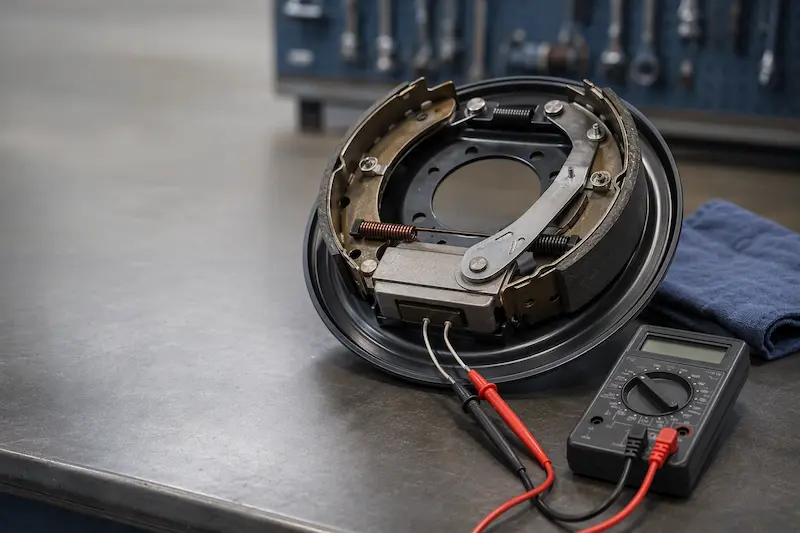
The brake magnet is the part that makes electric trailer brakes work, and it fails slowly. Stops grow longer, the controller gain climbs a notch each season, and the driver assumes the trailer simply got heavier. By the time the magnet quits, the shoes and the drum have taken the damage with it.
At Weifang Top Trailer Accessories, we build electric brake assemblies for trailer makers across the United States, Canada, Australia, and New Zealand. Consequently, a failing brake magnet reaches our technical desk with the same story attached, and the owner has missed five clear warnings. This guide lists those five signs, explains the resistance test that confirms the diagnosis, and covers a brake magnet replacement that lasts.
1. What the Brake Magnet Does, and Why It Fails Slowly
A brake controller sends current to a coil inside the magnet, and the energized magnet pulls against the armature face machined into the drum. That movement drives a lever that spreads the shoes against the drum. Every part of that chain depends on the magnet, so the magnet controls the whole brake.
Wear follows two paths. The magnet face grinds against the armature whenever the magnet air gap sits too tight, and the coil cooks whenever it runs hot for months. Above all, both paths announce themselves long before the brake fails, which is why the five signs below matter.
2. Sign One: Weak Brakes That Demand More Controller Gain
The first sign appears at the controller, not at the wheel. The driver raises the gain a little each month to keep stopping distances normal, and eventually the setting runs near maximum. A worn magnet and a widened magnet air gap both reduce the force the magnet can apply, so the driver compensates for a mechanical fault with an electrical fix.
Therefore, treat a climbing gain setting as a failing brake magnet warning rather than a preference. Check the gap first, because the air gap costs nothing to adjust, and our guide to setting the magnet air gap shows the procedure. If the force stays weak after a correct adjustment, the magnet itself has worn.
3. Sign Two: The Trailer Pulls to One Side Under Braking
A magnet that weakens on one wheel changes the balance of the whole trailer. The stronger side grabs first, and the trailer pulls toward it under braking. The driver feels it through the tow vehicle, and the pull grows as the magnet condition worsens.
Measure to confirm the diagnosis. A multimeter across each magnet coil reveals a difference between the two sides of the axle, and that difference explains the pull. Meanwhile, check the ground connections as well, because a poor ground on one side mimics a weak magnet and costs nothing to repair. Contaminated shoes can also cause a pull, so review the worn brake shoe symptoms if the coils read evenly.
4. Sign Three: Growling, Scraping, or Grinding Noise
A healthy set of electric trailer brakes runs quietly, so any growl or scrape deserves attention. A magnet that has worn through its friction face exposes metal, and the exposed surface grinds against the armature. The noise usually grows with speed, and it often appears before the braking force drops far.
In addition, a loose or broken magnet retainer lets the magnet shift and chatter inside the drum. Both faults damage the armature surface, and a damaged armature needs the same attention as the magnet. As a result, noise is the most urgent of the five signs, because the damage compounds with every mile.
5. Sign Four: Excessive Heat, a Burning Smell, or a Blue Magnet Face
Heat tells the clearest story of all. A magnet that drags generates constant friction, and constant friction cooks the coil, the shoes, and the drum. The owner smells it at a stop, feels it at the hub, and sees it as a blued or discolored magnet face when the drum comes off.
For example, a magnet air gap set too tight creates exactly this condition, and a controller running at full gain to fight voltage drop adds more heat on top. A blued surface means the part has already overheated, and an overheated magnet rarely recovers its strength. Test the coil, then plan the replacement.
6. Sign Five: Visible Magnet Wear or Coil Damage
The fifth sign hides inside the drum, and only an inspection finds it. Pull the drum and examine the magnet face, the coil, and the leads. A thinning face, grooves, discoloration, cracked insulation, or a broken lead all point to a failing brake magnet, and none of them repairs itself.
| Sign | What you notice | Likely cause | Action |
|---|---|---|---|
| Weak brakes | Gain keeps climbing | Worn magnet or wide air gap | Set the gap, then test the coil |
| Pull to one side | Trailer veers under braking | Uneven coil or bad ground | Compare coil readings side to side |
| Grinding noise | Growl that rises with speed | Magnet face worn through | Inspect the magnet and armature now |
| Excess heat or smell | Hot hub, blued magnet face | Dragging magnet or high gain | Correct the gap, test, then replace |
| Visible damage | Grooved face, cracked insulation | Age and heat | Replace the brake assembly |
The five warning signs of a failing trailer brake magnet, and what each one means.
7. Test and Replace a Brake Magnet the Right Way
Confirm the diagnosis with a multimeter before you buy parts. Disconnect the magnet leads, measure the coil resistance, and compare the reading with the specification for your brake size. Interpret the result as follows.
| Reading | What it means | Action |
|---|---|---|
| Open circuit (no reading) | Broken coil or lead | Replace the assembly |
| Far below specification | Shorted windings | Replace the assembly |
| Large difference side to side | One magnet is failing | Replace as an axle set |
| Within specification | Coil is sound | Check gap, ground, and shoes |
Moreover, measure the current draw at the brake with the controller at full output, because a coil can read correctly and still fail under load. Then follow three rules at replacement. First, replace magnets as a matched set across the axle, so braking stays balanced. Second, reface the armature whenever you fit new magnets and fit new magnets whenever you reface the armature, because the two surfaces must match. Third, set the magnet air gap and break in the new shoes before a heavy tow.
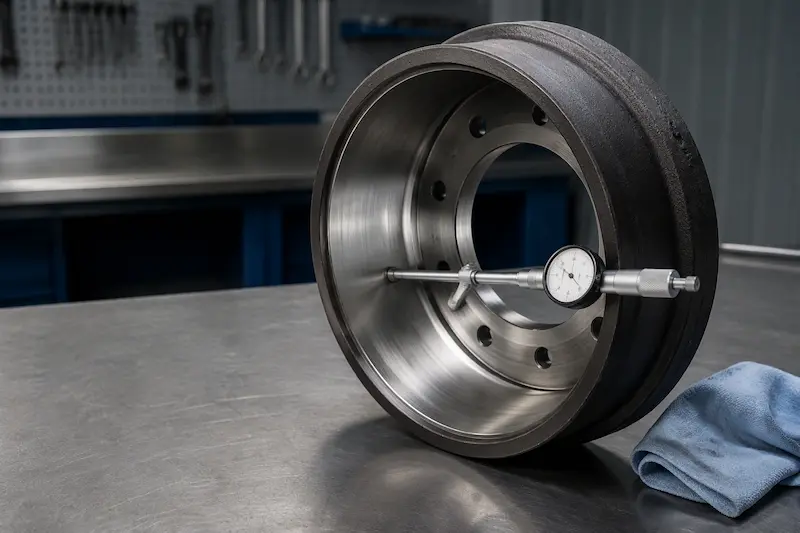
Dexter’s installation and service instructions cover the armature and magnet service, and the trailer running gear service manual published in a NHTSA technical bulletin lists the full wheel-end schedule. For parts identification, the etrailer electric trailer brakes guide walks through a typical assembly for reference. Our electric brake assembly range covers the common sizes, and the brake drum measurement guide explains the armature surface that the magnet rides on.
FAQ: Failing Brake Magnet
How do I test an electric trailer brake magnet? Disconnect the magnet leads and measure the coil resistance with a multimeter, then compare the reading with the specification for your brake size. An open circuit, a very low reading, or a large difference between the two sides of the axle points to a failing brake magnet.
What causes a brake magnet to fail? Three causes dominate: a magnet air gap set too tight so the magnet drags on the armature, chronic overheating from an overloaded axle or a dragging brake, and a controller that runs at high gain to compensate for voltage drop. All three wear the coil and the magnet face.
How long do electric trailer brake magnets last? Magnet life depends on the gap, the load, and the wiring rather than on a fixed mileage. A correctly set electric brake can run tens of thousands of miles, while a magnet that drags from a tight gap wears out in a fraction of that distance.
Do I need to replace both brake magnets at once? Replace magnets as a matched set on the axle, and replace the assembly on every braked wheel of that axle. A new magnet working against a worn one brakes unevenly and pulls the trailer, so the axle pair should always match.
Can I replace only the magnet instead of the whole assembly? A worn magnet often travels with worn shoes, a scored armature, and stretched springs, so a magnet-only repair rarely lasts. A complete brake magnet replacement as part of a new assembly restores matched surfaces and costs little more than the individual part.
Why do my trailer brakes pull to one side? Uneven braking usually means one magnet pulls harder than the others, which happens when a magnet wears unevenly or when a coil degrades on one side. A failing trailer brake magnet on one wheel, a bad ground, or a contaminated shoe can all cause the pull.
Conclusion: Read the Signs Before the Magnet Quits
A failing brake magnet warns the driver five different ways, and each warning costs less to fix than the one that follows it. A climbing gain setting, a pull to one side, a new grinding noise, a hot hub with a blued magnet face, and visible coil damage form a sequence that ends in failed electric trailer brakes. Read the signs early, confirm them with a resistance test, and plan the brake magnet replacement as a matched axle set.
At Weifang Top Trailer Accessories, we build electric brake assemblies, magnets, drums, and axles, and we supply matched wheel-end packages that keep braking balanced. Consequently, a trailer brake magnet that matches its armature and its partner arrives ready to install. Browse our electric brake assembly range, review our OEM and ODM programs, or send us your brake specification for a same-day quotation.