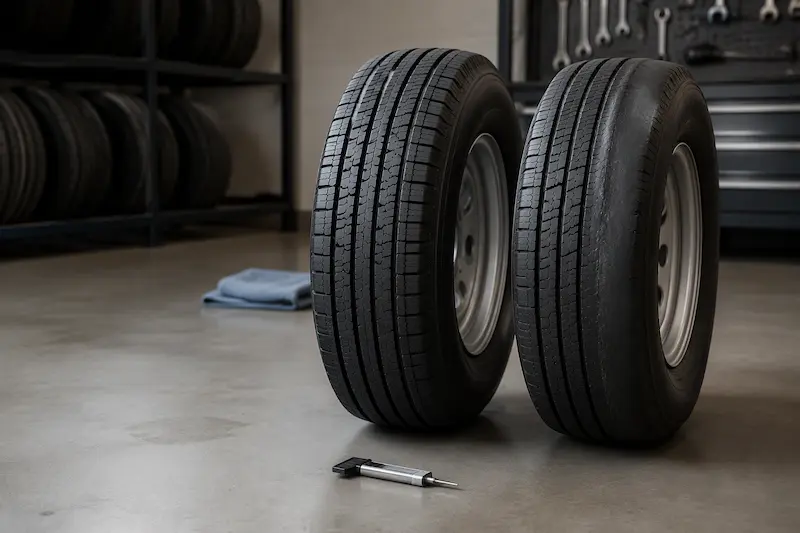
A trailer tire wears to the cords in a few thousand miles while its twin on the opposite side looks nearly new. The owner buys a replacement, and the new tire wears the same way. That repeat failure is the clue: uneven trailer tire wear rarely comes from a bad tire, and it usually comes from the axle underneath it.
At Weifang Top Trailer Accessories, we machine axles, spindles, hubs, and brake assemblies, and we measure alignment every day. Consequently, we see the same pattern return to our technical desk, and owners spend money on rubber when they should spend it on geometry. This guide shows how to read tire wear patterns, how to separate tire faults from axle faults, and how to check trailer axle alignment at home.
1. Why Owners Blame the Tire First
The tire is the visible part, so it takes the blame. It also carries a warranty, which makes a claim feel like the obvious first move. The axle, by contrast, hides under the trailer, where nobody looks until a tire fails twice.
In addition, a tire that wears unevenly looks like a defective product. It is not. A tire simply follows the angle it runs at, and the axle sets that angle. Above all, treat tire wear patterns as a fingerprint: read it first, then decide whether the tire or the axle wrote it.
2. Read the Wear Pattern Before You Buy Tires
Every wear pattern points to a cause, and the shape of the wear separates the two suspects. The table below maps the common patterns to their likely origin.
| Wear pattern | Likely cause | Look first at |
|---|---|---|
| One shoulder worn, other edge clean | Axle camber wrong for the load | Axle beam angle, load weight |
| Diagonal, feathered tread ribs | Toe misalignment | Trailer axle alignment |
| Cupping or scalloped spots | Wheel balance, bearing play, or a bent rim | Wheel, bearing preload |
| Both shoulders worn evenly | Underinflation | Tire pressure |
| Centre rib worn, shoulders clean | Overinflation | Tire pressure |
| All tires on one side worn | Axle shifted on the spring seats | U-bolts, spring seats |
| One tire worn, others fine | Dragging brake or hot bearing | Brake drag, hub temperature |
Trailer tire wear patterns, their likely cause, and where to look first.
For example, a symmetric pattern on both shoulders points to pressure, while a one-sided pattern points to geometry. That single distinction saves a wasted tire purchase.
3. Axle Cause One: Camber Wrong for the Load
Manufacturers build positive camber into a straight trailer axle, a subtle upward bow in the beam. Under the rated load, the beam flexes and the camber drops toward zero, so the tire runs flat against the pavement. That design only works when the load matches the axle rating.
An overloaded axle keeps flexing past its design point, and an axle rated far above the real load never flexes enough. In both cases, the axle camber sits wrong under the operating weight, and the tire wears on one shoulder while the other edge stays clean. Our article on axle camber and toe tolerances explains the geometry and how to measure it on a loaded trailer.
4. Axle Cause Two: Toe Misalignment
Toe describes whether the front of the tires points inward or outward, and nearly every straight trailer axle targets zero toe. A small toe misalignment grows into large tire damage, because the tire scrubs sideways on every rotation. An error of 1/8 in. across the tire diameter drags each tire roughly 28 feet sideways for every mile traveled.
Meanwhile, the tread shows the result as feathering, a sawtooth edge on the tread ribs. Three faults create toe error: a spindle welded at the wrong angle during manufacture, an axle shifted on the spring seats after an impact, and a trailer frame that sits out of square. As a result, the fix depends on which one you find, and the string method in section 7 identifies the axle position first.
5. Axle Cause Three: Axle Shift and Spring Seat Problems
Hard impacts shift an axle on its spring seats, and that shift turns a straight axle into a crooked one relative to the frame. The axle itself keeps perfect toe, yet it tracks at an angle, and the trailer dog-tracks down the road. Every tire on the affected axle then wears faster on one side than the other.
Check for the telltale sign: clean metal where the U-bolts used to sit, which shows that the axle has moved. Therefore, verify U-bolt torque at every service, and inspect the spring seats for wear. A repositionable shift is a suspension problem with a simple fix, while a bent spindle is an axle problem that ends in replacement.
6. When the Tire Really Is at Fault
The axle causes most uneven trailer tire wear, and the tire still causes some of it. Pressure sits at the top of that list: underinflation wears both shoulders, and overinflation wears the centre rib. Both patterns stay symmetric across the tread, which separates them from axle wear.
Balance and hardware cause the rest. A wheel out of balance cups the tread, a bent rim scallops it, and a dragging brake or a hot bearing overheats one tire and scrubs it flat. Finally, check the load and the speed rating, because an overloaded tire fails from heat rather than from geometry. Standards bodies such as SAE publish technical work on trailer axle dynamics and tire wear modelling for readers who want the deeper engineering.
7. Diagnosing and Fixing: A Field Checklist
Work through these checks in order, and the cause usually appears within the first three.
- Set the pressure first. Inflate to the trailer placard figure and re-check after a week, because a slow leak mimics a geometry fault.
- Check camber with the trailer loaded. Load the trailer to its normal weight, park on level ground, and read the angle at the tire sidewall with a digital angle finder.
- Check toe with the string method. Stretch a string along each side at axle height, then compare the distance to the front and rear edge of every tire.
- Inspect the spring seats and U-bolts. Look for clean metal where the U-bolts moved, and check the torque against the specification.
- Feel each hub after a run. A hub hotter than its neighbour points to a dragging brake or a bearing problem.
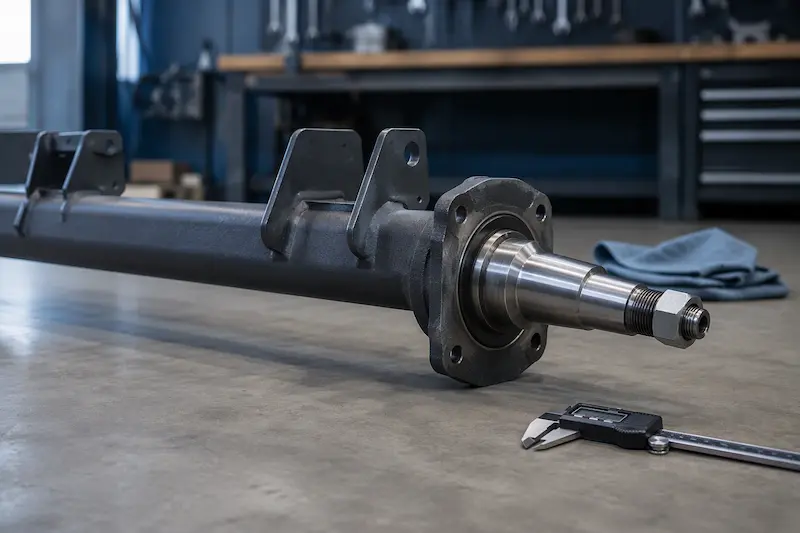
- Check for a bent spindle. A visible tilt at the spindle, or damage from a curb strike, means the axle needs replacement.
Dexter’s installation and service instructions cover the bearing and wheel-end checks that support an alignment diagnosis, and the trailer running gear service manual published in a NHTSA technical bulletin lists the full service schedule. Consequently, a diagnosis takes an afternoon, while a second ruined set of tires takes a season.
FAQ: Uneven Trailer Tire Wear
Why does one trailer tire wear faster than the others? A single fast-wearing tire usually points to a local fault: a bent spindle, a dragging brake, a wheel bearing running hot, or a bent rim. When one side wears faster than the other, trailer axle alignment such as toe or camber is the more likely cause.
What causes feathered tire wear on a trailer? Feathered tire wear points to toe misalignment. The tread ribs show a sawtooth edge where the tire scrubs sideways with every rotation. A trailer axle with wrong toe drags each tire sideways, which turns a small angle error into rapid, angled tread wear.
Can a bent axle cause uneven trailer tire wear? Yes. A bent axle changes the axle camber and toe it was built with, so the tire runs at the wrong angle. Because the spindle is welded to the beam in a fixture, a bent beam or spindle cannot be adjusted back into spec and calls for a replacement axle.
How do I check trailer axle alignment at home? Use the string method. Stretch a string along each side of the loaded trailer, then compare the distance from the string to the front and rear edge of each tire. A difference under 1/16 in. is acceptable; a larger difference signals a toe problem.
Does tire pressure cause uneven trailer tire wear? Yes, and the pattern tells the story. Underinflation wears both shoulders of the tread, while overinflation wears the centre. Pressure problems produce a symmetric pattern on both sides of the tread, which separates them from the one-sided or feathered wear that axle alignment causes.
Will new tires fix uneven trailer tire wear? No. New tires inherit the same alignment, so they wear exactly like the tires you replaced. Diagnose the wear pattern and correct the axle or the pressure problem first, then fit new tires, or the second set will fail the same way.
Conclusion: Diagnose the Pattern, Then Buy Tires
Uneven trailer tire wear tells a story, and the tread writes the cause. Camber error wears one shoulder, toe misalignment feathers the ribs, and a pressure fault wears the tread symmetrically. Read tire wear patterns first, check the trailer axle alignment second, and buy new tires last, because a second set fails exactly like the first one.
At Weifang Top Trailer Accessories, we build trailer axles with controlled camber and toe, and we match complete wheel-end packages to each axle rating so the tires run true. As a result, our customers track their axles to the load instead of replacing tires twice a season. Browse our trailer axle range, review our OEM and ODM programs, or send us your axle specification for a same-day quotation.