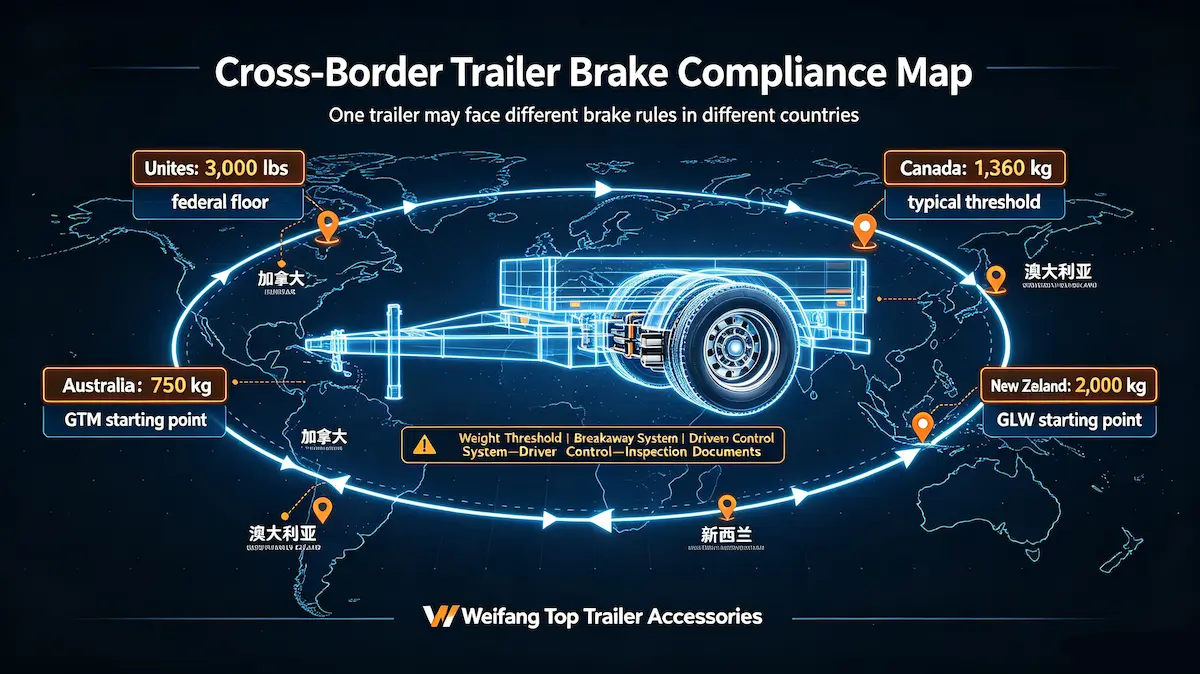
You pack your trailer in Texas, drive it across the border into Ontario, ship it to Queensland, and eventually register it in Auckland. Each time you cross a border, the legal requirements for your trailer’s brake system change — sometimes slightly, sometimes dramatically. A trailer that complies perfectly with US federal standards may fail a Canadian provincial inspection. An Australian-spec brake system may exceed New Zealand’s minimum requirements but lack the breakaway documentation a NZTA inspector expects.
For brake component manufacturers, exporters, and fleet operators who move trailers across these four major English-speaking markets, understanding the regulatory differences is not academic — it determines which products you can sell into which market and whether a cross-border trailer remains road-legal.
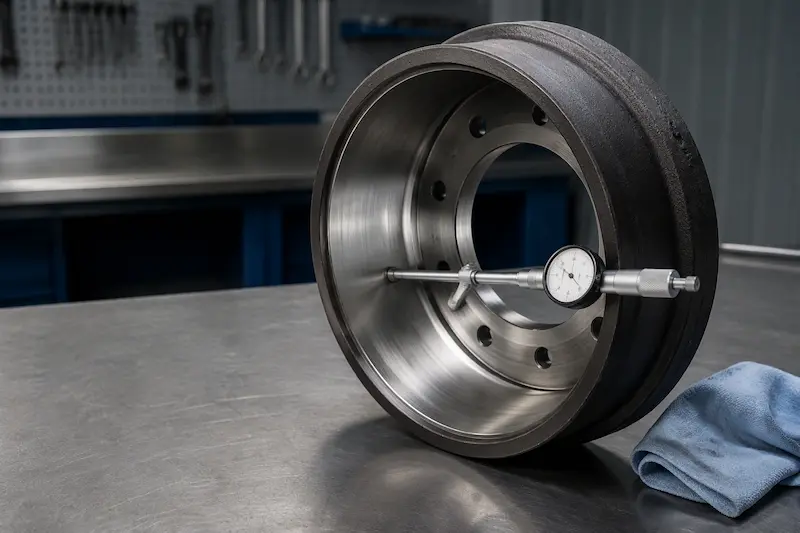
At Weifang Top Trailer Accessories, we supply brake assemblies, brake drums, axles, and trailer components to all four of these markets. This guide compares the brake regulations of the United States, Canada, Australia, and New Zealand — weight thresholds, system requirements, breakaway rules, and key compliance differences — so you know exactly what each jurisdiction demands.
Comparison at a Glance
United States: Federal Framework with State-Level Variations
The United States operates a two-tier regulatory system: federal minimum standards set by the Federal Motor Carrier Safety Administration (FMCSA) under the Federal Motor Vehicle Safety Standards (FMVSS), plus individual state laws that may impose stricter requirements.
Federal Standard: FMCSA §393.42
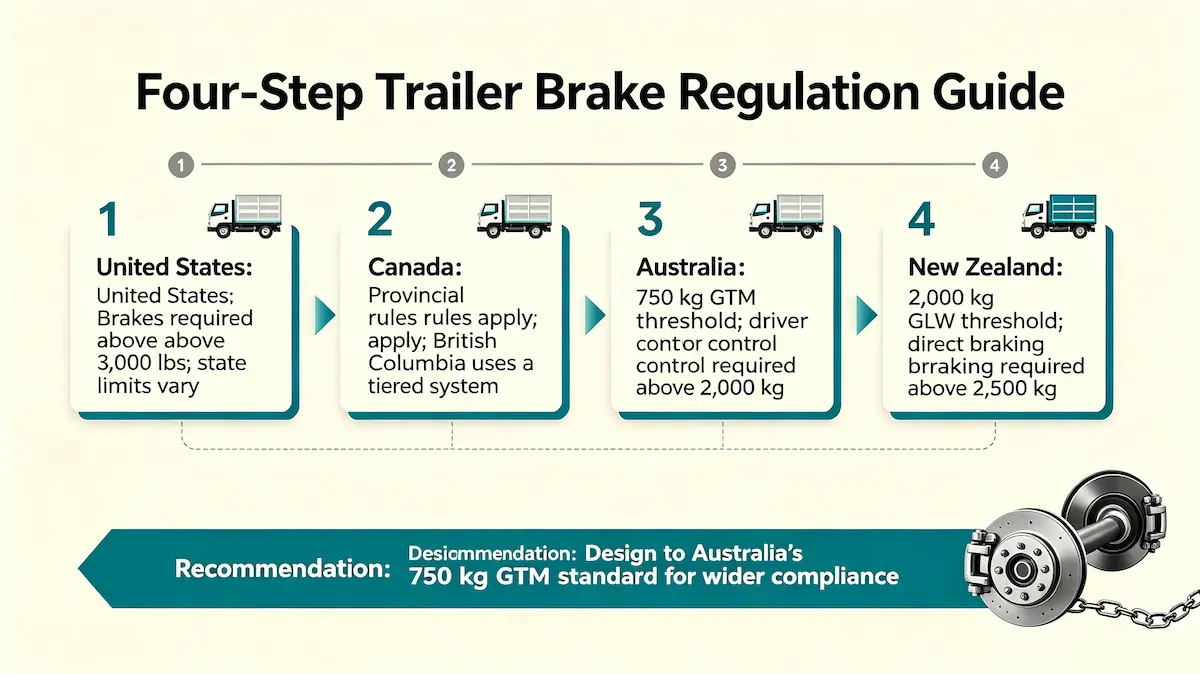
The core federal rule, codified at 49 CFR §393.42, states that every trailer with a gross weight exceeding 3,000 pounds must have brakes acting on all wheels. Furthermore, these brakes must operate automatically in the event of a breakaway. The regulatory language is clear: when the trailer exceeds 3,000 lbs, you need brakes on every wheel, and those brakes must be adequate to stop and hold the trailer.
For trailers under 3,000 lbs, federal law does not require brakes. However, this is where state law becomes critical.
State-Level Requirements: A Patchwork of Thresholds
Individual states set their own brake requirements, and the thresholds vary considerably:
- 1,000 lb threshold: North Carolina for house trailers; several states use this for specific trailer types.
- 1,500 lb threshold: California, Idaho, Nevada, New Hampshire, and others require brakes on trailers exceeding 1,500 lbs.
- 3,000 lb threshold: Alabama, Arizona, Arkansas, Kentucky, and roughly half of all states follow the federal 3,000 lb minimum.
- 4,000–5,000 lb threshold: A few states, including Alaska (5,000 lbs), set the threshold higher.
Additionally, some states use a stopping-distance test rather than a weight threshold: the combined vehicle and trailer must stop within a specified distance (typically 40 feet from 20 mph). This performance-based standard provides flexibility but requires actual testing to confirm compliance.
Practical implication: If you manufacture or sell brake components into the US market, the largest addressable segment sits at 1,500–3,000 lbs — the range where state laws diverge. A trailer in this weight range may legally operate without brakes in Alabama but requires them in California. Manufacturers selling nationally typically spec brakes at the 1,500 lb threshold to ensure compliance in all 50 states.
Breakaway Requirements
Federal law requires breakaway brakes on all trailers equipped with brakes. The breakaway system must apply the brakes automatically if the trailer separates from the tow vehicle. While the FMCSA does not specify a minimum hold time in the regulation itself, the industry standard (drawn from best practice and adopted by most state enforcement agencies) is 15 minutes of sustained brake application after activation.
Our guide to brake controller setup covers the in-cab side of US brake compliance, including the critical warning: never test the breakaway system while the 7-way connector remains plugged in, because the breakaway battery back-feeds into the controller circuit and can destroy the unit.
Key Takeaway for the US Market
Sell brake components rated for at least 3,500 lbs to cover the widest range of US trailer applications. Manufacturers exporting to the US should ensure their electric brake assemblies meet the SAE and FMVSS standards referenced by US enforcement agencies.
Canada: Provincial Regulations with No Single Federal Standard
Canada does not have a single national trailer brake regulation. Instead, each province and territory sets its own requirements through its Highway Traffic Act or equivalent legislation. This creates a more fragmented landscape than the US, because the differences between provinces are embedded in law rather than being variations on a federal floor.
Common Canadian Weight Thresholds
Despite the provincial variation, most Canadian jurisdictions converge on similar numbers:
-
910 kg (2,000 lbs): Alberta, Manitoba, and Yukon set the threshold at or near 910 kg, making them the strictest jurisdictions. Trailers exceeding this weight require brakes. Breakaway brakes also required in Alberta and Manitoba at this threshold.
-
1,300–1,400 kg (2,867–3,080 lbs): Quebec (1,300 kg), Ontario (1,360 kg), Saskatchewan (1,360 kg), British Columbia (1,400 kg), and Northwest Territories (1,360 kg) set thresholds in this range. This effectively means brakes are required on virtually any trailer above roughly 3,000 lbs.
-
1,500 kg (3,308 lbs): Prince Edward Island and New Brunswick use 1,500 kg.
-
1,800 kg (3,969 lbs): Nova Scotia sets the highest threshold among the Atlantic provinces.
-
4,500 kg (9,923 lbs): Newfoundland and Labrador maintains the highest threshold, requiring brakes only above 4,500 kg or when the trailer uses two or more axles.
The 50% Rule
Several provinces — including British Columbia, Alberta, and Yukon — apply a “50% rule” in addition to the absolute weight threshold: brakes are required if the trailer’s gross weight exceeds 50% of the towing vehicle’s licensed weight, even if the trailer falls below the absolute threshold. This rule captures small trailers towed by lightweight vehicles. A 1,500 lb trailer behind a 2,500 lb compact car triggers the brake requirement in BC even though 1,500 lbs sits below the 3,080 lb absolute threshold.
British Columbia’s Tiered System
British Columbia operates the most structured tiered system among Canadian provinces:
BC’s driver-operable control requirement at the top tier is significant: it means any trailer over 2,800 kg must have an electric brake system with an in-cab controller. A mechanical surge/override system on a 3,000 kg trailer is specifically illegal in British Columbia.
Breakaway Requirements
Most provinces require breakaway brakes at or near their standard brake threshold. BC specifies a 15-minute hold capability. The RVDA of Canada’s consolidated provincial brake regulations document provides the most reliable single reference for manufacturers and importers targeting the Canadian market.
Key Takeaway for the Canada Market
Design brake systems for the 910 kg (2,000 lb) threshold to cover Alberta, Manitoba, and Yukon — the strictest jurisdictions. For trailers over 2,800 kg, ensure the system supports driver-operable electric control; surge brakes will not comply in several provinces. Our electric brake assemblies meet Canadian provincial requirements when paired with a compatible brake controller.
Australia: ADR/VSB1 — A Clear, Weight-Based National Standard
Australia applies a single national standard through the Australian Design Rules (ADR) and Vehicle Standards Bulletin 1 (VSB1), which covers trailers with an Aggregate Trailer Mass (ATM) of 4.5 tonnes or less. If you understand two weight metrics — ATM and GTM — the regulatory framework is straightforward.
Key Weight Definitions
- ATM (Aggregate Trailer Mass): The total weight of the trailer plus its maximum payload, measured when the trailer is not coupled to a tow vehicle. This is the number on the compliance plate.
- GTM (Gross Trailer Mass): The weight transmitted to the ground by the trailer wheels when coupled. GTM = ATM minus the tow ball download. This is the figure used for brake requirement calculations.
Australia’s Three Braking Tiers
The Driver-Operable Requirement
The requirement for driver-operable brakes on trailers exceeding 2,000 kg GTM is the single most important compliance point for component suppliers. Override brakes cannot meet this requirement because they activate passively through trailer momentum — the driver cannot manually apply them from the cabin. An electric brake system with an in-cab controller, or an electric-over-hydraulic actuator, satisfies this requirement.
Additional Australian Requirements
- Breakaway battery monitoring: New South Wales specifically requires that the driver can see the breakaway battery’s charge level from the driver’s seat. A visual or audible low-voltage alert meets this requirement.
- Safety chains: Trailers up to 2,500 kg ATM require at least one safety chain complying with AS 4177.4. Trailers between 2,500 kg and 3,500 kg ATM require two compliant chains. Chains must cross under the drawbar in a dual-chain setup.
- Axle ratings: The axle must carry a stamped rating that matches or exceeds its portion of the GTM. A 45 mm or 50 mm square axle is standard for braked tandem setups.
Key Takeaway for the Australia Market
The 2,000 kg GTM threshold is the critical compliance line. Any trailer above this weight needs an electric brake system with driver control and a breakaway kit. Our brake drum and axle products support Australian builds in the 751–2,000 kg and 2,000+ kg tiers.
New Zealand: NZTA Light Trailer and Heavy Vehicle Standards
New Zealand’s trailer brake regulations fall under the NZ Transport Agency (NZTA) and apply through the vehicle inspection (Warrant of Fitness / WoF) system. Light trailers (up to 3,500 kg gross laden weight) follow one set of rules; heavy trailers follow the Heavy Vehicle Brake Code.
Light Trailer Brake Requirements (Up to 3,500 kg GLW)
New Zealand vs. Australia: Key Differences
Although Australia and New Zealand share many standards and product supply chains, their trailer brake regulations differ in important ways:
- Unbraked threshold: Australia sets the threshold at 750 kg GTM. New Zealand sets it at 2,000 kg GLW — nearly three times higher. A 1,500 kg trailer operates legally without brakes in New Zealand but requires them in Australia.
- Direct braking threshold: Australia requires driver-operable brakes above 2,000 kg GTM. New Zealand requires them above 2,500 kg GLW.
- Breakaway requirement: Australia requires breakaway brakes at 2,000 kg GTM. New Zealand requires them at 2,500 kg GLW.
- Inspection regime: New Zealand’s WoF system requires a physical inspection of brake components during annual or six-monthly checks, with specific pass/fail criteria for brake performance, cable condition, and fluid leaks. Australia’s inspection requirements vary by state.
Breakaway Brake Testing for WoF
For trailers in the 2,501–3,500 kg GLW range, the NZTA vehicle inspection manual requires that breakaway brakes actually function during the WoF test. The inspector pulls the breakaway pin and confirms the brakes engage and hold. This means New Zealand trailer owners cannot ignore breakaway system maintenance — a dead breakaway battery means a failed WoF inspection.
Key Takeaway for the New Zealand Market
The 2,500 kg GLW threshold for direct braking and breakaway systems is the key number for component suppliers. Trailers below this weight use simpler systems or operate unbraked. Above it, the requirements mirror Australia’s >2,000 kg tier but shift 500 kg higher. When you supply the same components to both Australia and New Zealand, a system designed for Australia’s 2,000 kg threshold easily satisfies New Zealand’s 2,500 kg threshold.
Cross-Border Compliance: Practical Scenarios
Scenario 1: A US-Manufactured Trailer Sold into Canada
A trailer built in Michigan and sold to an Ontario buyer must meet Ontario’s Highway Traffic Act requirements, not US federal standards. Ontario requires brakes above 1,360 kg (3,000 lbs) — matching the US federal threshold but not matching states with higher limits. If the trailer was originally built for a state with a 4,000 lb threshold and shipped without brakes because the manufacturer assumed US rules applied, it would fail Ontario requirements if its gross weight exceeds 1,360 kg.
Recommendation: For trailers destined for the Canadian market, build to the strictest applicable provincial threshold (910 kg / 2,000 lbs in Alberta, Manitoba, and Yukon).
Scenario 2: Towing a US-Registered Trailer Through Canada
A US resident towing through Canada on vacation generally operates under reciprocity agreements — Canadian provinces accept US-registered trailers as compliant if they meet their home jurisdiction’s requirements. However, this reciprocity typically covers short-term travel, not permanent importation. If the trailer is unsafe by local standards, enforcement officers retain the authority to issue an out-of-service order regardless of its home registration.
Scenario 3: Exporting Australian-Spec Trailers to New Zealand
Australia and New Zealand share similar brake system designs and many component suppliers. An Australian trailer with electric brakes and a breakaway system compliant for >2,000 kg GTM automatically meets New Zealand’s >2,500 kg GLW requirements. However, the compliance documentation — ADR certification vs. NZTA WoF inspection — differs. Ensure the trailer’s compliance plate presents information in the format the destination country’s inspectors expect.
Scenario 4: A Single Trailer Sold into All Four Markets
A manufacturer designing a trailer for sale in the US, Canada, Australia, and New Zealand should build to the lowest common threshold for brakes: Australia’s 750 kg. A trailer spec’d with electric brakes from 750 kg GTM upward meets or exceeds every requirement across all four markets. This over-specification adds cost on the lightest trailers but eliminates the compliance risk of shipping unbraked trailers into markets that require brakes.
Brake System Types and Cross-Market Acceptance
Different brake system types face different levels of acceptance across the four markets.
Electric Drum Brakes
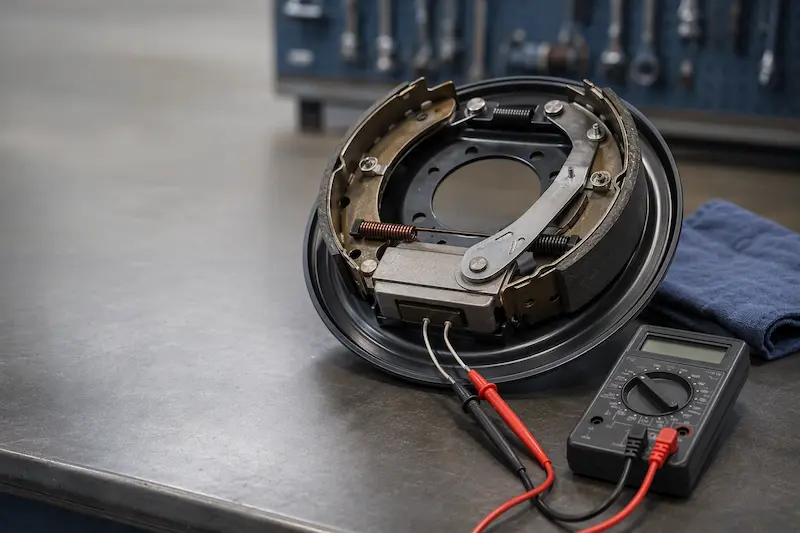
Electric drum brakes are the most universally accepted system. All four markets permit them, and they satisfy the driver-operable control requirement in all jurisdictions when paired with an in-cab brake controller. This makes 10-inch electric drum brakes the safest default choice for multi-market trailers. Our guide to brake magnet failure signs helps owners in any of these markets diagnose common electric brake problems.
Mechanical Override / Surge Brakes
Mechanical override brakes face the strictest limitations:
Override brakes are cost-effective and simple, but their inability to provide driver-operable control limits their application to lighter trailers in all four markets.
Hydraulic Disc Brakes
Hydraulic disc brakes — whether surge-activated or electric-over-hydraulic (EOH) — provide superior stopping power and corrosion resistance. For boat trailers operating in saltwater environments, hydraulic disc systems combined with an EOH actuator meet the driver-operable control requirement in all four markets for trailers above their respective direct-control thresholds.
Compliance Documentation: What Each Market Expects
Beyond the physical brake components, each market requires specific documentation:
Frequently Asked Questions (FAQ)
Which country has the strictest trailer brake regulations?
Australia has the strictest overall framework. Its 750 kg GTM threshold for requiring any brakes is the lowest in the world among major trailer markets. Additionally, the 2,000 kg GTM threshold for driver-operable brakes on all wheels with a breakaway system covers a wider range of trailers than equivalent thresholds in other markets. However, specific Canadian provinces — Alberta and Manitoba at 910 kg — are stricter than Australia at the lowest end for absolute brake requirements.
Do I need a brake controller in all four countries?
You need a brake controller whenever your trailer exceeds the driver-operable control threshold: 2,800 kg in British Columbia, 2,000 kg GTM in Australia, and 2,500 kg GLW in New Zealand. In the US and most other Canadian provinces, any electric brake system requires a controller regardless of trailer weight. Override/surge systems do not require a controller in any market because they activate mechanically.
Can I use the same trailer across all four countries without modifications?
Possibly, if you spec it for the strictest requirements: brakes on all wheels from 750 kg GTM, an electric system with in-cab controller, and an ADR-compliant breakaway kit with a 15-minute hold battery. However, the compliance plate and documentation must meet each market’s format requirements, and some local modifications (lighting, reflectors, chain specifications) may still apply. Consult the destination market’s current vehicle standards bulletin before assuming cross-border compliance.
What happens if I tow across a US state line with non-compliant brakes?
Enforcement varies significantly. Some states actively inspect trailer brake compliance at weigh stations and during traffic stops; others rarely enforce brake requirements on non-commercial trailers. However, if you cause an accident while towing a trailer that does not meet the brake requirements of the state where the accident occurs, the legal and insurance consequences can be severe regardless of whether your home state’s requirements are different.
Do electric brake requirements differ for off-road trailers?
All four markets apply their brake regulations to any trailer that operates on public roads, even if the trailer’s primary use is off-road. A camper trailer designed for off-road use that travels public roads to reach the trailhead must meet road-going brake requirements. Some markets have limited exemptions for agricultural equipment and construction machinery, but recreational off-road trailers do not qualify for these exemptions.
How often do trailer brake regulations change?
Regulations change infrequently but occasionally in significant ways. British Columbia updated its trailer brake requirements in recent years. Australia’s VSB1 undergoes periodic revision (Revision 6 was published in July 2025). Monitor the regulatory bodies — FMCSA in the US, provincial transport ministries in Canada, the Department of Infrastructure in Australia, and NZTA in New Zealand — for updates. Component suppliers should review their product compliance against current standards at least annually.
Know the Rules Before You Cross the Line
Trailer brake regulations in the four major English-speaking trailer markets share a common logic — heavier trailers need more capable brakes — but the specific thresholds, system requirements, and documentation standards differ enough to trip up unwary manufacturers and importers. Australia leads in strictness with its 750 kg threshold. Canada leads in complexity with its provincial patchwork. New Zealand offers the most forgiving unbraked threshold at 2,000 kg. The United States splits the difference with a 3,000 lb federal floor and widely varying state requirements.
For component suppliers, the practical path is clear: build brake systems that satisfy Australia’s requirements (the strictest market), and your products will comply everywhere. For trailer owners crossing borders, check the rules of your destination before you depart. A few minutes of research prevents a roadside defect notice — or worse.
At Weifang Top Trailer Accessories, we manufacture brake assemblies, brake drums, axles, jockey wheels, and other trailer parts that meet or exceed the requirements of all four markets. Our components ship to customers throughout the United States, Canada, Australia, and New Zealand.
Contact our team to discuss compliance requirements for your target market, request product specifications and certifications, or place an order. Browse our full product catalog online.