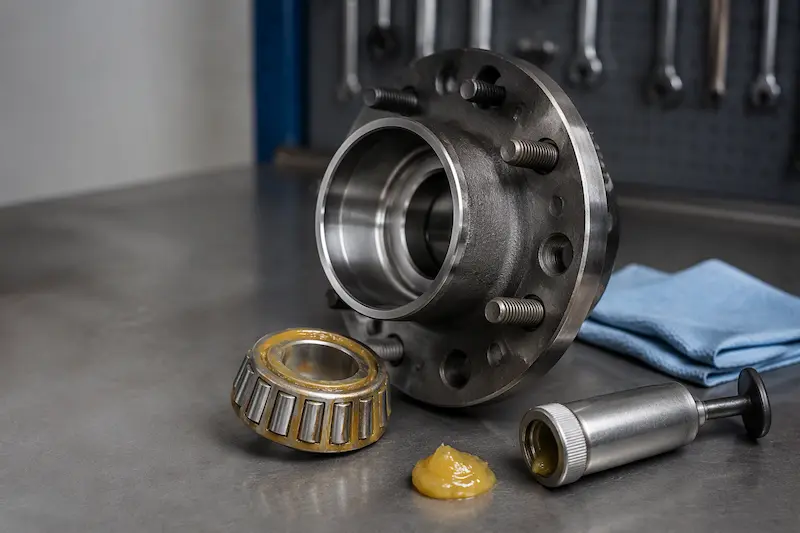
Two claims about wheel ends run through every trailer forum, and both of them destroy bearings. The first claims that an oil bath hub never needs service. The second claims that grease is the old way and oil is the upgrade. Neither claim survives contact with a real axle, and the bearings pay the price.
At Weifang Top Trailer Accessories, we machine hubs, spindles, bearings, and axles for trailer makers across the United States, Canada, Australia, and New Zealand. Consequently, seized bearings arrive at our technical desk with a full oil bath or a fresh grease pack, which proves the lubricant was never the problem. This guide explains how each system works, why the maintenance-free claim fails, and how real trailer hub maintenance protects bearings.
1. The Myth, Stated Plainly
The debate over grease vs. oil bath hubs rests on two assumptions, and both of them mislead. The first assumption says that an oil bath hub runs forever without attention. The second says that grease belongs to an older generation of trailers and that oil is simply better. Neither assumption matches how a wheel end behaves in service.
In addition, trailer wheel bearings demand the same three conditions in either system: a full lubricant charge, intact seals, and the correct bearing preload. Remove any one of those conditions, and the bearing fails no matter what fills the hub. Above all, judge a hub by its seals and its adjustment, not by the fluid inside it.
2. How a Grease Hub Works
A grease hub holds a packed charge of grease inside the bearing and around it. The rollers carry the load through a film of grease, and the grease also blocks water and dirt at the seal lip. Because grease stays in place, it tolerates slow speeds and short trips well, and it survives a brief dunking at a boat ramp.
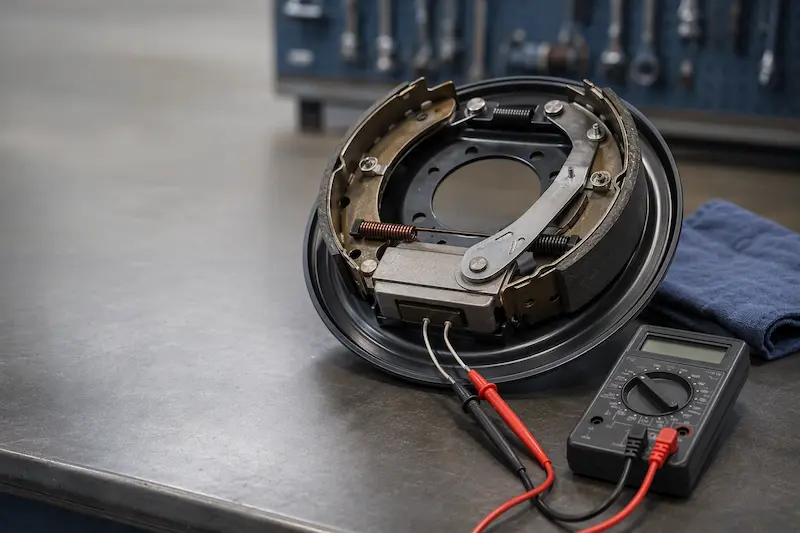
However, grease degrades. Heat, water, and age break it down, so a grease hub needs a periodic repack to replace the charge and inspect the rollers. Over-greasing through a grease fitting causes its own damage: excess pressure pushes past the rear seal, and the grease travels onto the brake shoes and the drum. If you suspect that leak, check the worn brake shoe symptoms before you replace parts.
3. How an Oil Bath Hub Works
An oil bath hub carries a pool of oil inside the hub cavity, held at a marked level and visible through a clear cap or a plug. The oil circulates as the wheel turns, so it carries heat away from the bearing better than grease does. That cooling advantage makes the design popular on long-haul and heavy trailers, where bearings run hot for hours.
Oil bath hubs therefore depend on two seals, not one. A positive rear seal keeps the oil inside and the water outside, and a front cap with a clear window holds the charge and lets you read the level. A worn seal or a loose cap empties the hub, and the oil bath hub fails faster than a grease hub in that condition, because nothing remains to lubricate the bearing.
4. Why the Maintenance-Free Claim Fails
An oil bath hub reduces the repack interval, and it does not remove the work. The owner must read the oil level and inspect the seals, because a slow leak gives no warning until the bearing howls. Water does the rest: it enters through a cold seal after a water crossing, and it turns the oil milky.
Meanwhile, grease hubs fail in their own ways. A hub packed with the wrong preload overheats, and a hub that never gets a repack runs dry. As a result, the failure mode looks identical in both systems, and it points to the same three causes. The table below compares the two designs on the points that decide bearing life.
| Factor | Grease hub | Oil bath hub |
|---|---|---|
| Heat removal | Moderate | Better, because oil circulates |
| Level or charge check | At repack | Frequent, through a clear cap |
| Submersion tolerance | Good for a brief dunking | Poor; water enters a cold seal |
| Leak consequence | Grease reaches the brakes | Bearing runs dry, then seizes |
| Typical duty | Utility, boat, seasonal trailers | Long-haul and heavy trailers |
| Service focus | Repack and seal replacement | Level and seal inspection |
Grease vs. oil bath hubs: practical comparison for trailer wheel ends.
5. Where Each System Wins
Match the system to the duty cycle, and the choice becomes clear. A trailer that sits for months, backs into a lake, or runs short local trips suits a grease hub, because grease holds its place through idle time and light water contact. A trailer that runs long distances at highway speed suits an oil bath hub, because the circulating oil manages heat that would cook a grease charge.
For example, a boat trailer owner who converts to oil bath hubs usually regrets it after the first launch, because water finds the seal. In contrast, a hotshot hauler who runs a thousand miles a week benefits from the cooling. Neither design wins everywhere, so read the duty cycle first.
6. The Real Bearing Killers, Whatever Fills the Hub
Four faults cause almost every trailer wheel bearing failure, and none of them involves the lubricant type. Fix these four, and the grease vs. oil bath hubs question matters far less.
- Wrong bearing preload. A nut set too tight heats the rollers; a nut set too loose lets the hub move and brinells the races.
- Contamination. Water and grit enter through a worn seal or a missing cap and grind the rollers.
- Lubrication loss. A failed rear seal lets the charge escape, and the bearing runs dry.
- Mismatched parts. Bearings work as matched cone-and-cup sets, so a mixed set seats poorly and fails early.
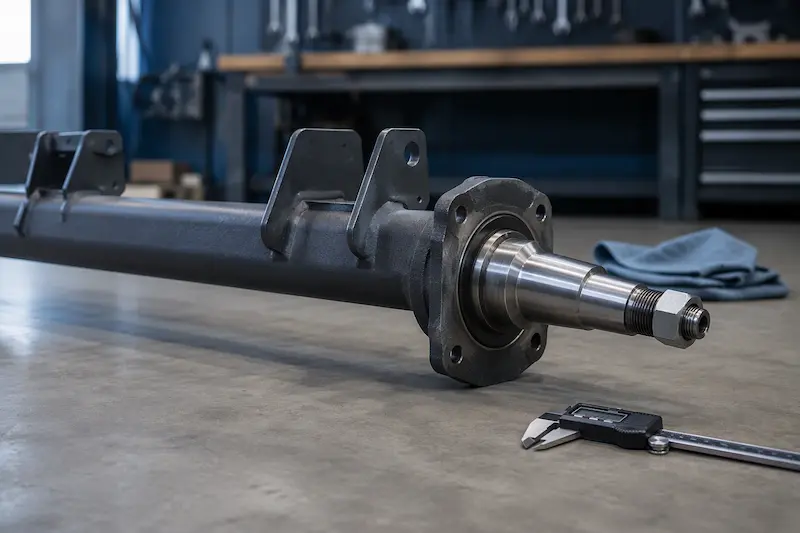
Finally, never mix lubricants inside one hub. Adding oil to a grease hub, or topping up with an incompatible grease, breaks down both charges. Our axle parts guide shows how the spindle, cone, cup, and seal stack together, and it explains why each part must match.
7. Trailer Hub Maintenance That Protects Bearings
Both systems reward a short, regular routine. The table below sets out the practical schedule that most trailer shops apply, and the manufacturer’s instructions always take priority.
| Task | Grease hub | Oil bath hub |
|---|---|---|
| Check charge or level | At repack | Every trip or season |
| Repack or renew lubricant | Yearly or every 12,000 miles | Per manufacturer, with seal service |
| Inspect seals and caps | Every repack | Every level check |
| Check hub temperature | After the first miles | After the first miles |
Consequently, a grease hub service means a full repack, a new seal, and a correct preload. An oil bath hub service means a level reading, a look for milky oil, and a seal inspection. On both, replace the seal at every service, because a cheap seal costs far less than a bearing and a tow. Our comparison of dust caps vs. hub caps explains the cover that keeps the wheel end sealed, and the oil seal replacement guide covers the leak that starts the damage. Dexter’s installation and service instructions set out the bearing and seal procedures that trailers follow in the field.
FAQ: Grease vs. Oil Bath Hubs
Are oil bath hubs really maintenance-free? No. An oil bath hub still needs a level check and a seal inspection, because a slow leak empties the hub and destroys the bearing quietly. Oil bath hubs reduce the repack interval, and they do not remove the need for trailer hub maintenance.
Which is better for boat trailers, grease or oil bath? Grease suits boat trailers better, because a grease hub tolerates brief submersion while an oil bath hub does not. Water enters an oil bath hub through a cold seal and turns the oil milky, so most boat trailers run grease or a sealed bearing system.
Can I switch a grease hub to an oil bath hub? Only when the hub and the seal are built for oil. Oil bath hubs need a positive rear seal and a front cap that holds oil, and a grease hub often lacks those parts. A conversion also needs a clean cavity, because leftover grease contaminates the oil.
How often should I repack trailer wheel bearings? Repack trailer wheel bearings once a year or every 12,000 miles, whichever comes first, and check a boat trailer every season. Inspect more often after any deep water crossing or a long, hot trip with a heavy load. The trailer running gear service manual published in a NHTSA technical bulletin lists the full service schedule.
What causes trailer wheel bearings to fail? Three causes dominate: incorrect bearing preload, contamination from water or dirt, and lubrication loss through a failed seal. The lubricant type rarely causes the failure, which is why the grease vs. oil bath hubs debate misses the real problem.
What grease should I use for trailer wheel bearings? Use a wheel-bearing grease rated for the duty, and never mix incompatible bases inside one hub. High-temperature greases for disc brakes differ from standard wheel-bearing greases, so confirm the rating before you pack a bearing.
Conclusion: Seals and Preload Beat the Debate
The grease vs. oil bath hubs argument treats the lubricant as the deciding factor, and the wheel end disagrees. A grease hub and an oil bath hub both protect trailer wheel bearings when the charge stays full, the seals stay intact, and the bearing preload stays correct. Lose any of those three, and the bearing fails with a perfectly good lubricant inside it.
At Weifang Top Trailer Accessories, we machine hubs, spindles, and axles, and we supply matched bearing and seal kits that remove the guesswork from trailer hub maintenance. As a result, every wheel end arrives as a system that packs, seals, and preloads the way the trailer needs. Browse our axle and hub parts range, review our OEM and ODM programs, or send us your hub and bearing specification for a same-day quotation.