
Electric trailer brakes only work when a brake controller tells them how hard to pull. The controller sits in your tow vehicle, senses your braking, and sends the right amount of power to the trailer’s brake magnets. Choose the wrong type, and you get jerky stops, premature wear, or dangerous under-braking in an emergency. In this guide, we explain what a trailer brake controller does, compare time-based and proportional units, and walk you through setup so your brakes respond smoothly every time.
What a Trailer Brake Controller Does
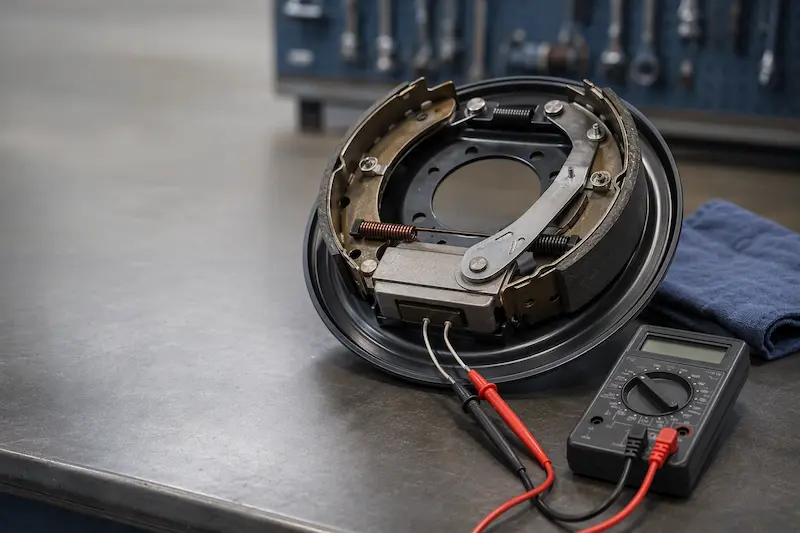
Electric brakes use electromagnets that drag against the drum face to actuate the shoes (our electric brake assemblies work this way). The controller supplies the voltage that energizes those magnets, and it decides when to start, how fast to ramp, and how much power to send. Without a controller, the magnets receive nothing and the brakes simply do not engage, so the controller is not an accessory — it is the system’s brain.
Two basic designs dominate the market. A time-based controller applies a preset amount of power for a fixed duration whenever you touch the brake pedal. A proportional controller measures your actual deceleration and matches the trailer’s braking force to it. The difference sounds subtle, but it changes how every stop feels. We cover each type in turn.
Time-Based Controllers Explained
A time-based (or timed) controller works on a simple schedule. The moment your brake lights come on, it starts sending power according to your gain and delay settings, runs for the set time, and then stops. You control two things: the gain, which sets the power level, and the delay, which sets how quickly the power ramps up.
The strengths. First, time-based units cost less, often half the price of a good proportional unit. Second, they work in any tow vehicle without special sensors or level mounting. Third, they are easy to understand — two knobs, one test drive, done. For occasional towing with a lighter trailer, this simplicity works well.
The weaknesses. The controller cannot tell how hard you are actually braking, so it delivers the same response whether you ease to a stop or slam the pedal. As a result, a hard stop under-brakes the trailer, while a gentle stop over-brakes it and drags the tires. Load changes also require manual gain adjustments, and hill descents need frequent tweaking. In short, time-based units trade smoothness for price.
Proportional Controllers Explained
A proportional controller contains an internal sensor — typically an accelerometer — that measures your tow vehicle’s deceleration in real time. When you brake gently, it sends gentle power; when you brake hard, it sends strong power instantly. Most units also let you set a gain level, and many include a boost setting for heavier trailers.
The strengths. First, stops feel natural because the trailer brakes in step with the truck. Second, emergency stops engage the trailer brakes immediately and powerfully, which shortens stopping distance exactly when it matters. Third, the system adapts automatically when you change trailers, because it reacts to actual deceleration rather than a timer. For towing in hills or with heavy loads, proportional control makes the biggest difference.
The weaknesses. Proportional units cost more, and the sensor needs a level mounting position and periodic recalibration after heavy use or load changes. Setup takes a little more care than a two-knob unit. Moreover, if you mount the unit at an angle, it misreads deceleration and brakes unevenly.
Time-Based vs. Proportional: Comparison
| Factor | Time-based | Proportional |
|---|---|---|
| Price | Lower | Higher |
| Braking feel | On/off style | Natural, matched |
| Emergency stops | Delayed response | Immediate response |
| Hill descents | Manual adjustment | Self-adjusting |
| Load changes | Adjust gain manually | Recalibrate on level ground |
| Setup complexity | Simple | Moderate |
| Best for | Occasional, light towing | Frequent, heavy, or hilly towing |
In practice, the Lippert comparison of time-delay and proportional controllers reaches the same conclusion: proportional units deliver smoother, safer stops, while time-based units win on price and simplicity.
How to Set Up Any Brake Controller
Whichever type you choose, the gain setup follows the same road test. First, park the trailer on dry, level pavement and set the gain low — about 30 to 40 percent on most units. Second, drive at about 25 mph and apply the brakes firmly. Watch the trailer in the mirror: if the brakes barely pull, increase the gain by one step and repeat. Third, when the trailer wheels just begin to lock or skid, back the gain down one step. That setting gives you maximum braking without flat-spotting tires.
For time-based units, also adjust the delay: too short and the trailer lurches, too long and the truck does all the work. For proportional units, park on level ground and press the calibrate button if your model has one, especially after changing trailers or loading. Finally, retest after any major load change, because gain that suits an empty trailer will under-brake a loaded one.
Wiring and Compatibility Essentials
A trailer brake controller needs a connection to your tow vehicle’s brake circuit and a power feed, and it sends its output through the brake wire in your 7-pin connector. If you also tow with the same vehicle for other trailers, a proportional unit handles different trailers better because it recalibrates to actual deceleration. Check the controller’s rating against your trailer’s brake magnet draw, and confirm your trailer’s brakes are in good condition first — a worn brake magnet makes any controller perform badly.
Keep compliance in mind as well. Federal standards define the performance of hydraulic and electric brake systems under FMVSS No. 105, and the NHTSA publishes the regulations that govern braking equipment. Our comparative guide to trailer brake regulations also shows when brakes become mandatory in each market, which tells you whether a controller belongs on your vehicle at all.
FAQ
Q1: Which is better — a time-based or proportional brake controller?
Proportional controllers brake more smoothly and respond faster in emergencies, which makes them better for frequent, heavy, or hilly towing. Time-based controllers cost less and work fine for occasional light towing.
Q2: Do I need a trailer brake controller for electric brakes?
Yes. Electric brakes receive power from the controller, and without it the magnets never energize. Hydraulic surge brake systems work differently and do not need a controller.
Q3: How do I know if my brake controller is adjusted correctly?
Set the gain so the trailer brakes firmly without locking at 25 mph on dry pavement. If the trailer pushes the truck in hard stops, raise the gain; if the wheels skid, lower it. Recheck after any load change.
Q4: Can I use one brake controller with different trailers?
You can, and a proportional unit adapts best because it measures real deceleration. Recalibrate on level ground whenever you switch trailers, and adjust gain for each load.
Q5: Why do my trailer brakes feel too aggressive or too weak?
Most likely the gain is wrong, but worn brake magnets, incorrect shoe adjustment, or a bad ground can also cause weak braking. Check the warning signs of failing brake magnets and inspect the brakes before blaming the controller.
Conclusion
Your trailer brake controller determines how well the whole braking system performs. Time-based units deliver simple, affordable control for light occasional towing, while proportional units give you smooth, responsive braking that shines on heavy loads and mountain grades. Set the gain correctly, recalibrate after load changes, and pair the controller with healthy electric brake assemblies and a properly rated trailer axle. Finally, if you need help matching brakes and axles to your tow setup, our engineers will review your application — contact us for guidance.