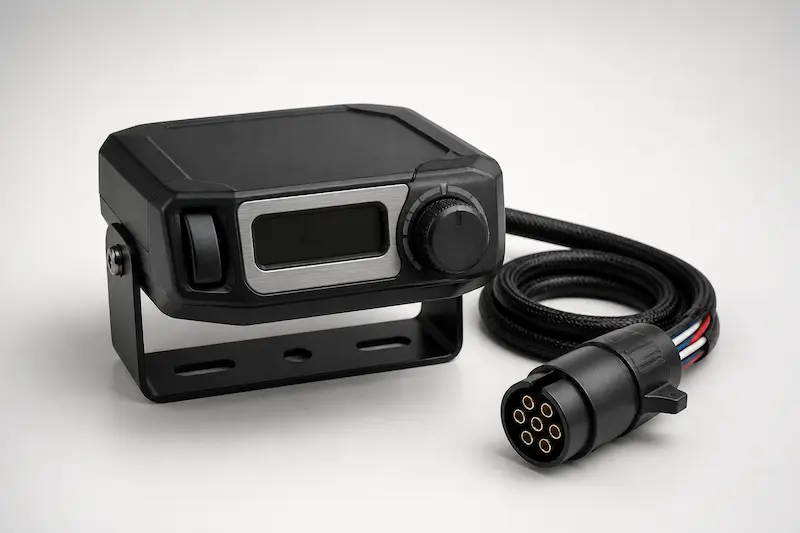
You have just bought a trailer with electric brakes — and suddenly the salesman mentions a “brake controller” as if everyone owns one. What is it, which one do you need, and how hard is the installation? If any of that sounds familiar, this guide is for you.
Here is what we will cover: the main types of trailer brake controller, how to size one for your trailer, and a straightforward step-by-step setup process.
Why Your Trailer Needs a Brake Controller
First, let us answer the “why.” Electric trailer brakes do not activate on their own — they need a signal from the tow vehicle, and that signal is produced by a trailer brake controller. In other words, without a controller, your electric brakes are just dead weight.
Safety regulators take this seriously. For example, the Federal Motor Carrier Safety Administration (FMCSA) enforces braking requirements for commercial vehicle combinations, while the National Highway Traffic Safety Administration (NHTSA) promotes brake checks as a core part of its trailer safety guidance. Therefore, if your trailer is equipped with electric brakes, a properly set up controller is both a safety device and, in many jurisdictions, a legal requirement.
Types of Trailer Brake Controllers
Now let us look at the options. Trailer brake controllers fall into two main families, plus a few installation variants.
Time-based controllers. These apply braking power on a fixed time ramp once you press the pedal — for example, full power after a set delay. They are cheaper and simpler, and they work well for light, predictable loads. However, because they ignore how hard you are actually braking, they can feel grabby or inconsistent on hilly roads.
Proportional (inertia-based) controllers. These use a pendulum or accelerometer to measure your vehicle’s deceleration and match the trailer’s braking force to it in real time. As a result, stops feel smooth and natural, which is why proportional units are the recommendation for most owners — especially those towing heavier trailers.
Installation variants. Controllers also come as permanent undermount units, portable plug-and-play models, and wireless units that sync with a smartphone app. Meanwhile, the underlying braking logic is the same; the choice mainly affects mounting and convenience.
Sizing a Trailer Brake Controller: What to Check
Sizing is less about physical size and more about compatibility. Here are the four things to verify before you buy:
- Brake count and amperage. Count your trailer’s brakes: a single-axle trailer typically has two brakes, a tandem axle has four, and a triple axle has six. Add up the amp draw — most electric brakes draw about 3 amps each — and make sure the controller’s rated output covers the total. Therefore, a four-brake trailer (about 12 amps) needs a controller rated for at least 15 amps, while heavier setups may require a 30-amp unit.
- Tow vehicle package. Confirm your truck has a 7-pin connector with a brake output pin, or plan for a wiring harness installation.
- Trailer weight. Heavier trailers benefit from proportional controllers with a higher gain range and boost settings.
- Mounting space. Measure the area under your dashboard if you are installing a permanent unit.
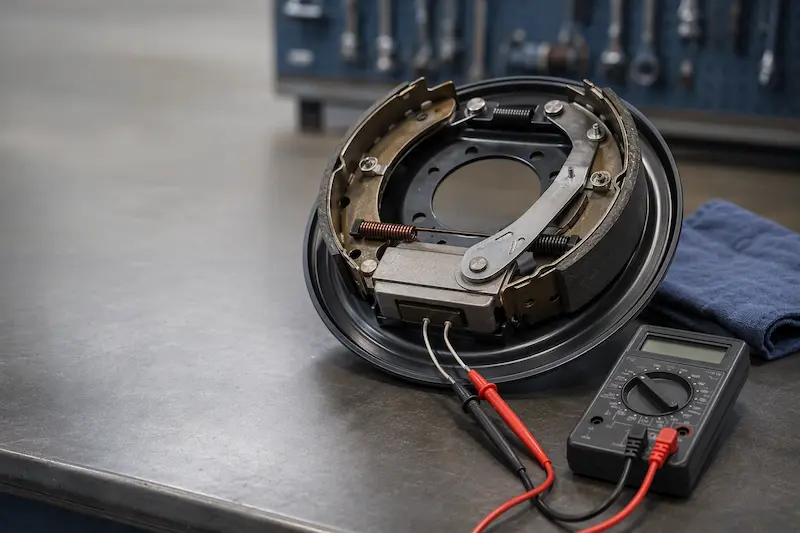
In addition, remember that the controller sends its signal to the magnets inside your electric brake assemblies — so overall braking performance also depends on the condition of the brakes themselves.
Step-by-Step Trailer Brake Controller Setup
Once you have the right unit, setup takes about an hour. Here is the sequence we recommend:
Step 1 — Mount the unit. Position the controller under the dash where you can reach it while driving, but out of the way of your knees.
Step 2 — Wire it in. Connect power, ground, and the brake signal wire. The 7-pin plug’s brake pin carries the output to the trailer; a solid chassis ground is essential, because a bad ground is the number one cause of weak or erratic braking.
Step 3 — Set the gain. Start low and test on an empty road at about 25 mph (40 km/h). Apply the brakes moderately: the trailer should “pull” gently on the truck — not lock up, and not lag behind. Then fine-tune in small increments.
Step 4 — Adjust boost and sync. Many proportional controllers offer a boost setting for heavy loads and a sync control that shifts the response curve. For instance, if the trailer brakes too early, reduce the sync; if it reacts too slowly, increase it.
Step 5 — Test the manual override. Use the controller’s manual lever or button to apply the trailer brakes alone, and confirm every wheel responds. If one wheel is sluggish, check the magnet air gap before blaming the controller.
Common Setup Mistakes to Avoid
Even a good trailer brake controller performs badly when it is set up wrong. Here are the mistakes we see most often:
- Gain set too high — brakes lock up, tires skid, and drums overheat. Consequently, drop the gain and re-test.
- Gain set too low — the trailer pushes into the truck at stops, and braking distance grows dangerously.
- Bad ground connection — intermittent or weak braking that drives owners crazy.
- Forgetting the breakaway switch test — the emergency braking system should be checked every season.
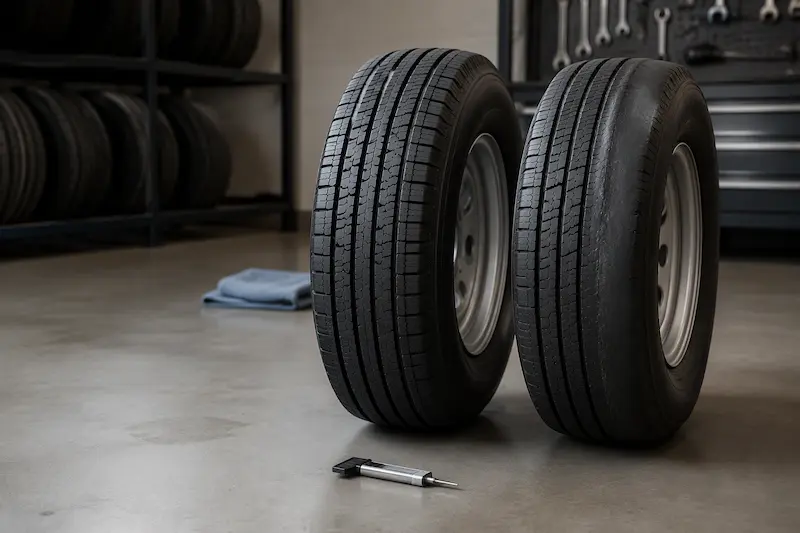
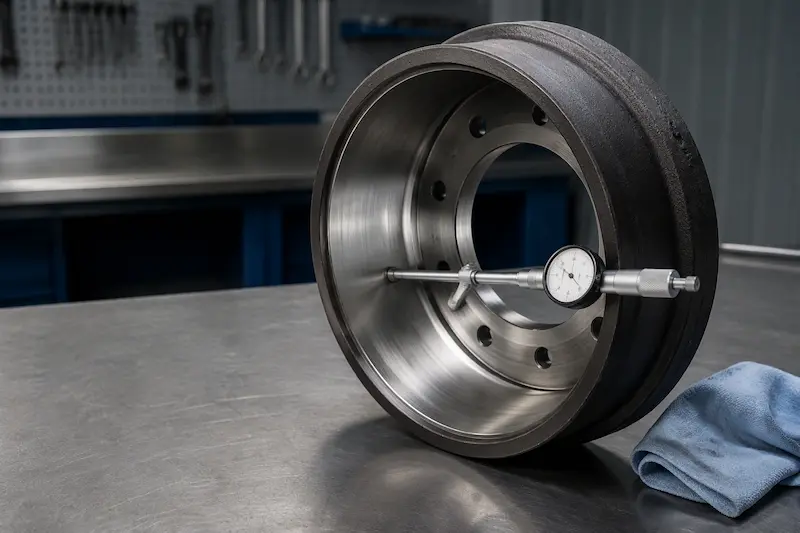
- Ignoring worn brakes — no controller can compensate for worn shoes or scored brake drums.
Specifically, if your system is several years old and the magnets will not hold a setting, the smarter fix is often a complete new electric brake assembly rather than chasing ghosts in the wiring.
Conclusion
To summarize, the right trailer brake controller for you is almost always a proportional model sized to your trailer’s brake count, installed with solid wiring, and tuned with a proper gain test. First, count your brakes; next, confirm your truck’s wiring; then, set the gain on an empty road — and your towing experience will transform overnight.
If you need help sourcing quality electric brake assemblies, brake drums, or complete trailer axles to pair with your new controller, our team is happy to advise. Visit our contact page for a quotation or product catalog — we reply within 24 hours.