
You are towing a camper down a busy two-lane road when the car ahead brakes suddenly. You press your pedal — and instead of a smooth stop, the trailer surges forward before the brakes finally bite. For first-time owners, that moment is both confusing and alarming, and it usually comes down to not understanding how the braking system actually works.
The good news is that electric trailer brakes are simpler than they look. In this guide, we will break down exactly how electric trailer brakes work, what every component does, and how to keep them performing safely for years.
Why Electric Trailer Brakes Matter
First, let us address why brakes matter so much on a trailer. A loaded trailer can double the weight your tow vehicle has to stop, and your truck’s own brakes are simply not designed to handle that load alone. As a result, federal safety regulators require braking systems on trailers above certain weight thresholds in many jurisdictions. For example, the Federal Motor Carrier Safety Administration (FMCSA) sets braking and stopping-distance requirements for commercial vehicle combinations, while the National Highway Traffic Safety Administration (NHTSA) promotes brake checks as a core part of trailer safety. Therefore, functioning trailer brakes are not a convenience — they are a safety requirement.
Moreover, electric brakes are the most popular choice for trailers in North America and Australia because they are reliable, affordable, and easy to maintain. In fact, that is exactly why our factory in Weifang specializes in electric brake assemblies for markets across the United States, Canada, Australia, and New Zealand.
The Core Components of an Electric Brake System
Before we get into how electric trailer brakes work, let us meet the key players. In fact, an electric brake system has only a handful of components:
- Brake controller — mounted in the tow vehicle; it sends an electrical signal whenever you brake.
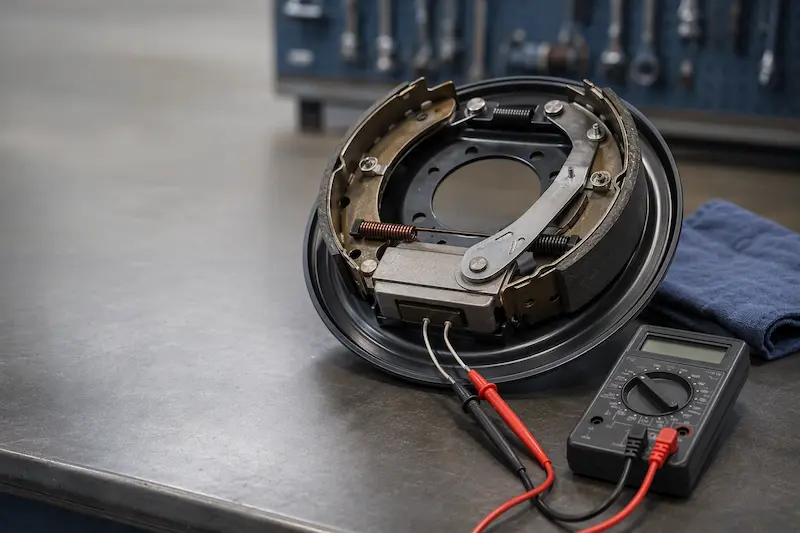
- Electromagnet — sits inside the brake assembly and is the heart of the entire system.
- Brake shoes — the friction material that presses outward against the drum.
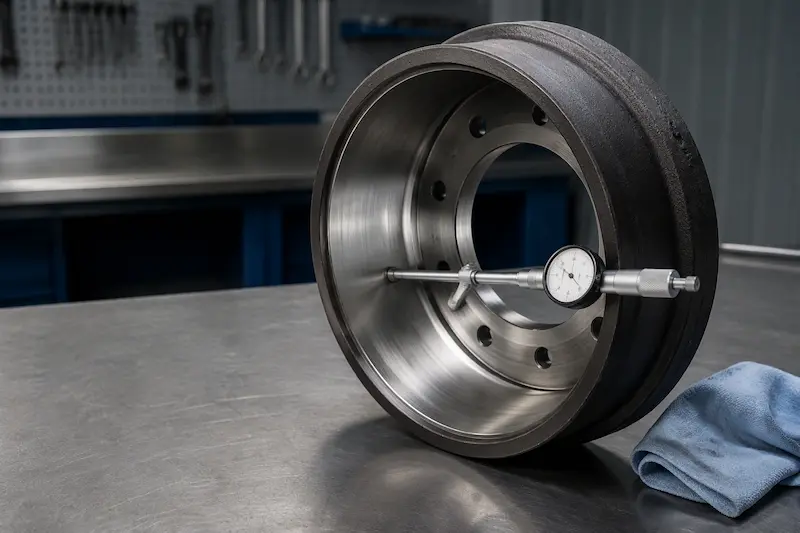
- Brake drum — the spinning metal surface that the shoes grip.
- Wiring and the 7-way plug — carries power and the brake signal from the truck to the trailer.
- Breakaway switch — applies the brakes automatically if the trailer ever detaches.
Every one of these parts works together in a sequence that takes less than a second.
How Electric Trailer Brakes Work: Step by Step
Now for the moment you have been waiting for. Here is exactly how electric trailer brakes work, step by step:
- Step 1 — You press the brake pedal. The brake controller reads the pedal pressure (or deceleration) and sends a proportional electric current to the trailer.
- Step 2 — The magnet energizes. That current flows through the wiring to the electromagnet inside each wheel’s brake assembly.
- Step 3 — The magnet drags against the drum. Because the magnet is spring-mounted while the drum is spinning, the energized magnet is pulled along by friction. Next, this dragging action rotates a small lever arm.
- Step 4 — The shoes push outward. The lever forces the brake shoes against the inside of the drum.
- Step 5 — Friction slows the wheel. The shoes grip the drum, converting the trailer’s momentum into heat. Then the trailer slows down in sync with the tow vehicle.
- Step 6 — You release the pedal. The current stops, the magnet releases, and the shoes retract.
Meanwhile, the harder you brake, the more current the controller sends, and the harder the shoes press — which is precisely why electric brakes feel “proportional.”
The Brake Controller: Your Command Center
The controller deserves a little extra attention, because it decides how much braking force you get. There are two main types: time-based controllers, which apply a fixed ramp of power once you brake, and proportional controllers, which measure your deceleration and match the trailer’s braking to it. For most first-time owners, a proportional controller offers a smoother, safer ride.
However, the controller is only as good as its setup. The gain (power level) must be adjusted so that the trailer brakes slightly before the tow vehicle. For instance, on a flat, empty stretch of road, a proper setting lets you feel the trailer “pull” gently on the truck when you brake at moderate pressure.
The Air Gap: The Detail That Matters
If you have ever heard a constant grinding sound from a wheel that never fully engages — or brakes that feel “grabby” — the culprit is usually the air gap. The air gap is the distance between the electromagnet and the drum face. When it is too large, the brakes engage slowly and weakly; when it is too small, they drag constantly and overheat.
Specifically, the air gap on most electric brake assemblies should sit between 0.020 and 0.030 inches, and it grows as the magnet wears down. Therefore, checking and adjusting it should be part of every seasonal inspection. We have written a dedicated guide on setting the magnet air gap the right way — it is well worth bookmarking.
Wiring and Common Troubleshooting
Now that you know how electric trailer brakes work, let us look at what happens when they stop working. In most cases, the problem is not the brake assembly itself but the wiring:
- Bad ground — the most common culprit. The trailer frame must have a solid ground return to the truck; otherwise, the magnets receive weak, erratic current.
- Damaged 7-way plug — corroded pins or a bent connector cause intermittent braking.
- Wrong controller settings — a gain set too low feels like “no brakes,” while a gain set too high makes the wheels lock up.
A quick test: with the trailer connected, manually apply the brake controller and listen at each wheel. You should hear a distinct “click” as the magnets energize. If a wheel stays silent, trace the wiring from the plug back to that wheel’s magnet. Consequently, most “brakes not working” stories end with a simple wire repair rather than a brand-new axle.
Maintenance Checklist for Electric Trailer Brakes
Even the best-built electric trailer brakes need routine care. Here is a practical checklist you can run through each season:
- Inspect the magnet faces for flat wear spots, and replace magnets that have worn thin.
- Check brake shoe thickness, and replace the lining when it drops below roughly 1/16 inch.
- Measure the drum’s inside diameter and look for heat cracks — browse our brake drum and disc range when replacement is due.
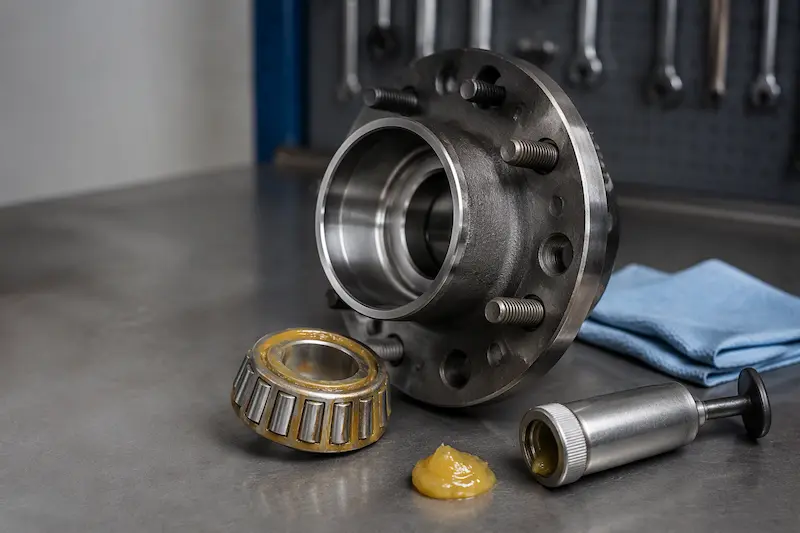
- Repack the wheel bearings and inspect the oil seals, and learn how to pick the right bearing cover in our dust caps vs. hub caps guide.
- Test the breakaway switch and its battery before every long trip, and keep an eye on the whole trailer axle assembly for wear.
In addition, keep the drums free of grease and dirt, since contamination dramatically reduces braking power.
When to Upgrade Your Brake System
Finally, if your trailer is older, tows heavier loads, or the magnets simply will not hold a setting anymore, an upgrade is often cheaper than you think. Complete electric brake assemblies — including the backing plate, magnet, shoes, and hardware — can be swapped out in an afternoon, and they bring fresh friction material and a new magnet to the table. That is why many of our customers choose complete assemblies rather than piecemeal repairs.
At Weifang Top, we manufacture electric brake assemblies to international quality standards, backed by 15 quality-control staff and a 10-engineer technical team, and we support both OEM and customized orders for distributors worldwide.
Conclusion
To summarize, electric trailer brakes work by turning your brake pedal into an electrical signal, using that signal to energize an electromagnet, and converting the magnet’s drag into pressure that presses the brake shoes against the drum. As a result, understanding how electric trailer brakes work turns mysterious brake problems into simple, fixable ones.
Whether you are maintaining a single trailer or sourcing parts for a fleet, we are happy to help. Visit our contact page for a quotation or a full product catalog — our team replies within 24 hours.