When you are towing several thousand pounds down a steep grade or navigating through a sudden downpour, your choice of braking system becomes the most critical safety factor. For decades, drum brakes were the industry standard, but disc brakes have rapidly gained ground in the trailer market.
At Top Axles, we often get asked: “Which one is actually better?” The answer depends on your towing environment, but from a purely technical standpoint, the differences in stopping power and maintenance are significant. Let’s dive into the technical comparison.
1. Stopping Power and Performance: The Heat Factor
The primary job of any brake is to turn kinetic energy (motion) into thermal energy (heat). How a brake handles that heat determines its “stopping power.”
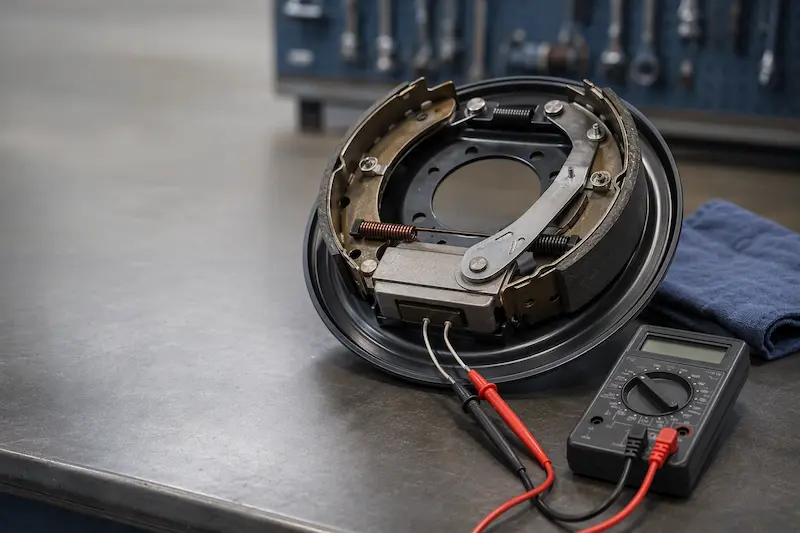
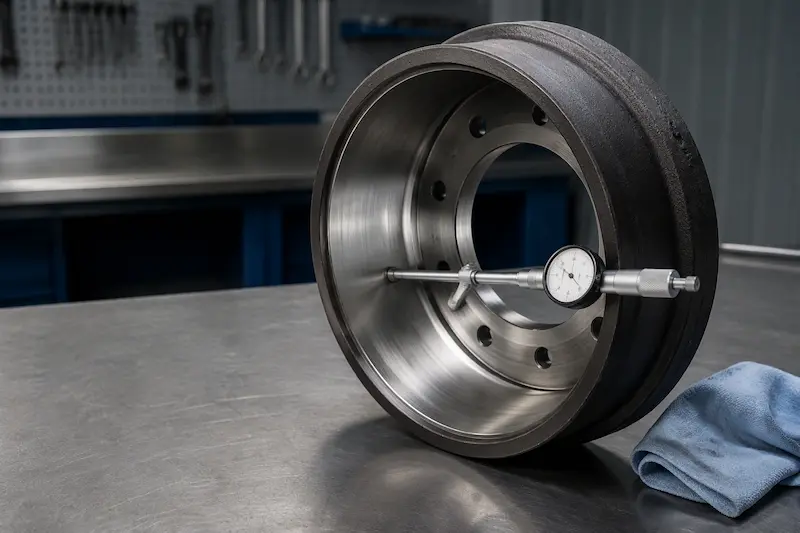
Drum Brakes: The Enclosed Classic
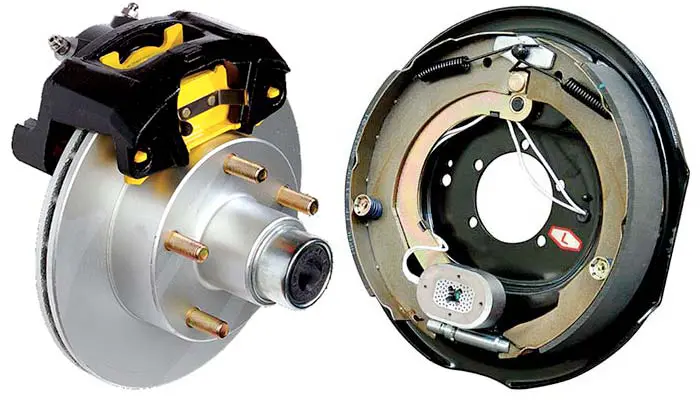
Drum brakes use a set of shoes that push outward against the inside of a spinning drum.
- The Problem: Because the components are enclosed, heat is trapped. During prolonged braking (like descending a mountain), the drum can expand away from the shoes, leading to brake fade—a terrifying loss of stopping power.
Disc Brakes: The Modern Powerhouse
Disc brakes use a caliper to squeeze pads against an exposed rotor.
- The Advantage: The open design allows air to flow freely over the rotor, dissipating heat almost instantly. Furthermore, as the rotor gets hot, it expands toward the pads, actually maintaining or even increasing contact pressure. In terms of raw stopping power, disc brakes consistently provide shorter, more reliable stopping distances.
2. Performance in Wet vs. Dry Conditions
Weather is the ultimate test of a trailer brake. This is where the design architecture makes the biggest difference.
- Dry Conditions: Both systems perform well, though disc brakes offer better modularity (the ability to apply precise braking force).
- Wet Conditions: Drum brakes act like a bowl; they can trap water inside the drum. When you hit the brakes, the water creates a thin film between the shoe and the drum, causing a delay in braking (hydroplaning).
- The Disc Advantage: Disc brakes are “self-cleaning.” The centrifugal force of the spinning rotor flings water off, and the pads act like a squeegee to clear the surface instantly. For boat trailers or those frequently used in rainy climates, disc brakes are the superior choice.
3. Maintenance and Durability
Maintenance is where the total cost of ownership is decided.
Drum Brake Maintenance:
- Complexity: They consist of many small parts—return springs, hold-down pins, and self-adjusters. These parts are prone to rusting and seizing, especially in salt-water or snowy environments.
- Adjustment: Most drum brakes require manual or periodic adjustment to keep the shoes at the correct distance from the drum.
Disc Brake Maintenance:
- Simplicity: A disc brake system has significantly fewer moving parts.
- Ease of Inspection: You can check pad wear and rotor condition without removing the wheel. This makes pre-trip safety checks much faster.
- Self-Adjusting: Disc brakes are inherently self-adjusting; as the pads wear down, the piston simply moves further out to maintain the same gap.
4. Cost vs. Value
There is no denying that drum brakes are more affordable upfront. If you have a light-utility trailer used occasionally for short trips, drum brakes are a cost-effective solution.
However, disc brakes provide a higher return on investment (ROI) for:
- High-Mileage Fleets: Lower maintenance downtime.
- Heavy Loads: Safety and reduced brake fade are priceless.
- Marine Use: Superior corrosion resistance and water shedding.
Summary Comparison Table
| Feature | Drum Brakes | Disc Brakes |
|---|---|---|
| Stopping Distance | Good | Excellent |
| Heat Dissipation | Poor (Prone to fade) | Excellent |
| Wet Performance | Fair (Traps water) | Excellent (Self-cleaning) |
| Maintenance | Complex (Many parts) | Simple (Few parts) |
| Initial Cost | Lower | Higher |
Conclusion: Which Should You Choose?
If your priority is safety, consistent stopping power, and ease of maintenance, disc brakes are the clear winner. They handle heat better, perform more reliably in the rain, and are easier to service. However, for budget-conscious projects or light-duty trailers, high-quality drum brakes remain a viable, time-tested option.
At Top Axles, we provide premium components for both systems. Whether you are looking to upgrade your current rig or building a trailer from scratch, our engineering team is here to help you find the perfect match.
Need to upgrade your trailer’s braking performance? Explore our High-Performance Axle and Brake Kits or Contact our Technical Support Team for expert advice.