Drum brakes are an old type of braking system still commonly found in vehicles today, especially in vehicles for the rear wheels. Unlike disc brakes, drum brakes are comprised of brake drums, which are fixed to the wheels, and brake shoes, which are positioned within the drum and press against it to slow or stop the vehicle. Let’s look at the working principle, main components, types, pros, and the issues they have.
How Drum Brakes Work
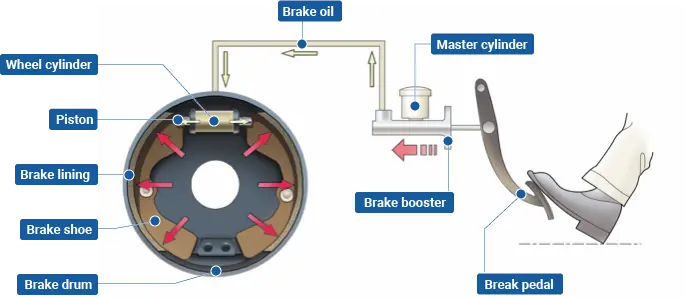
When the driver steps on the brake pedal, the power is amplified by the brake booster (servo system) and changed into hydraulic pressure (oil-pressure) by the master cylinder. The pressure reaches the brakes on the wheels via tubing filled with brake oil (brake fluid). The delivered pressure pushes the pistons on the brakes of the four wheels. The pistons press the brake linings, which are friction materials, against the inside surfaces of the brake drums which rotate with the wheels. The linings are pressed on the rotating drums, which in turn decelerate the wheels, thereby slowing down and stopping the vehicle.
Main Components of Drum Brakes
-
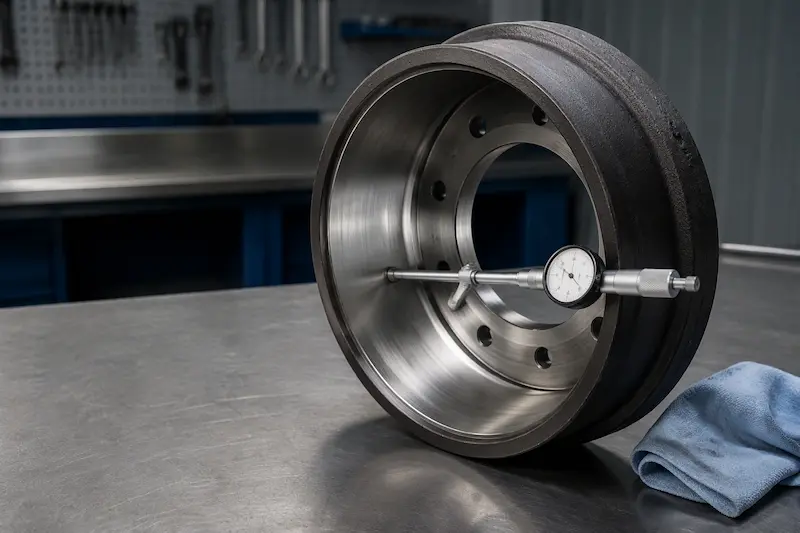
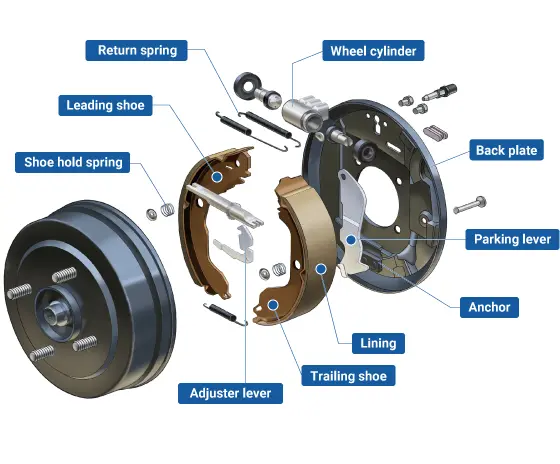
Brake Drum: Usually made of heat-resistant cast iron, the drum rotates with the wheel. Its inner surface comes into contact with the brake shoes to generate friction and decelerate the vehicle.
-
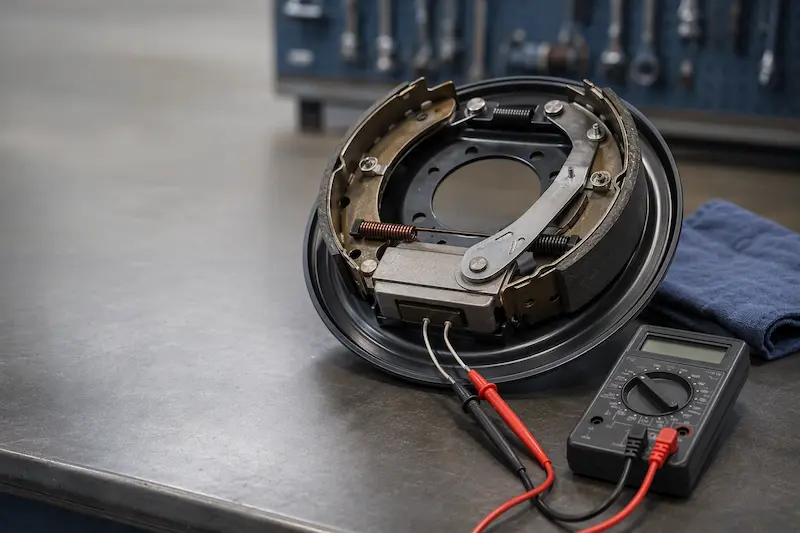
Brake Shoes:A brake shoe transfers braking force by pressing its friction-lined steel plate against the rotating drum. The assembly uses both a primary (leading) and a secondary (trailing) shoe, and engineers select their materials to provide heat resistance, wear resistance, and stable friction.
-
Wheel Cylinder: This component applies the braking force by using its pistons to push the brake shoes outward against the drum when hydraulic pressure acts upon them. The retraction springs then pull the shoes back when the driver releases the brake.
-
Backplate: Supports all components, provides rigidity, and absorbs braking torque. It also protects internal components from dust and debris.
-
Springs and Adjusters: Maintain the proper position of the brake shoes and ensure consistent contact with the drum. Automatic adjusters compensate for friction material wear over time.
Types of Drum Brakes
1. Leading/Trailing Shoe Type
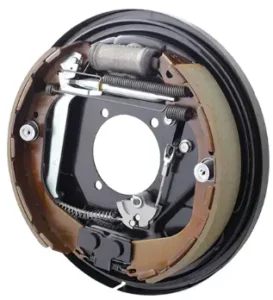
“Leading (or primary) shoe” refers to the brake shoe that moves in the direction of rotation when pressed against the drum. People call the other shoe the “trailing (secondary) shoe.” The leading shoe presses against the drum in the same direction as the drum’s rotation, and this rotation helps push the shoe against the drum with greater pressure, resulting in stronger braking force. This phenomenon, known as the servo effect (self-boosting effect), enables drum brakes to achieve powerful braking performance.
Structurally, it has a wheel cylinder housing a piston with which hydraulic pressure is generated to push the two shoes against the drum’s inner surface.
The two shoes function in a way they both become either the trailing shoe or leading shoe depending on whether the vehicle is travelling forward or backward. Drum brakes generate consistent braking force whether the vehicle travels forward or backward. This is because drum brakes generate the same braking force in either direction. Generally, this type is used for the rear brakes of passenger cars.
2. Twin Leading Shoe Type
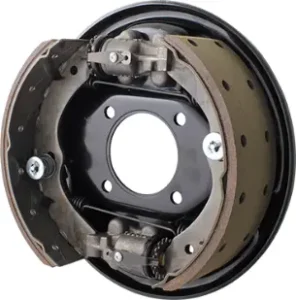
This type of drum brake has two wheel cylinders and two leading shoes. Each wheel cylinder presses on one shoe, so that both shoes act as leading ones when the vehicle moves forward, providing superior braking force.
Each of the pistons housed in the wheel cylinders displace in one direction, so when the vehicle is in reverse both shoes act as trailing ones. This type is used mainly for the front brakes of small-to-mid-sized trucks.
The dual twin leading shoe type has pistons that displace in both directions, making it possible for both shoes to act as leading ones, regardless of direction of travel. This type is mainly used for the rear brakes of small-to-mid-sized trucks.
3. Duo-Servo Type
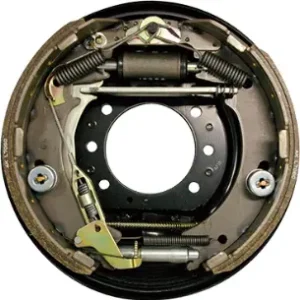
The duo-servo type incorporates a structure that links two brake shoes—the primary and secondary shoe—via an adjuster. The strong servo effect (self-boosting effect) generated by the primary shoe transfers directly to the linked secondary shoe, thereby producing a very large braking force.
Manufacturers mainly use this type of brake in parking brakes for passenger cars, center brakes for trucks, and braking systems on forklifts.
Advantages of Drum Brakes
-
Cost-effective production: Generally cheaper to manufacture than disc brakes.
-
Self-boosting effect: Requires less input force from the driver.
-
Durable friction surface: Brake shoes have a larger contact area with the drum, increasing wear life.
-
Integrated parking brake: Easily combines with mechanical parking brake systems.
-
Lower maintenance in some cases: Better corrosion resistance and fewer exposed components.
Lower heat generation and the need for long-lasting braking force lead automotive engineers to often choose drum brakes for rear-wheel applications. Additionally, designers of hybrid and electric vehicles commonly utilize them, as regenerative braking significantly reduces wear on the primary braking system.
Challenges and Limitations
Despite their advantages, drum brakes have several limitations:
-
Heat management: Prolonged or repeated braking can overheat the drum, reducing braking efficiency (brake fade).
-
Water and corrosion sensitivity: Water or rust can temporarily alter friction and reduce braking performance.
-
Maintenance complexity: More components and springs make drum brakes more difficult and time-consuming to service than disc brakes.
-
Potential for mechanical failure: Broken springs or adjusters can lead to unexpected brake behavior, including wheel lock or sticking.
Conclusion
Drum brakes remain a robust and economical solution for many vehicles, particularly for rear-wheel braking and parking brake integration. Their self-boosting effect, durability, and cost-effectiveness make them ideal for certain applications, despite the rise of disc brakes in modern vehicles. Proper maintenance, careful design for heat dissipation, and awareness of their operational limits ensure drum brakes continue to deliver reliable performance.
For more details on installation and specifications, visit our official product page or contact our technical support team for personalized assistance.