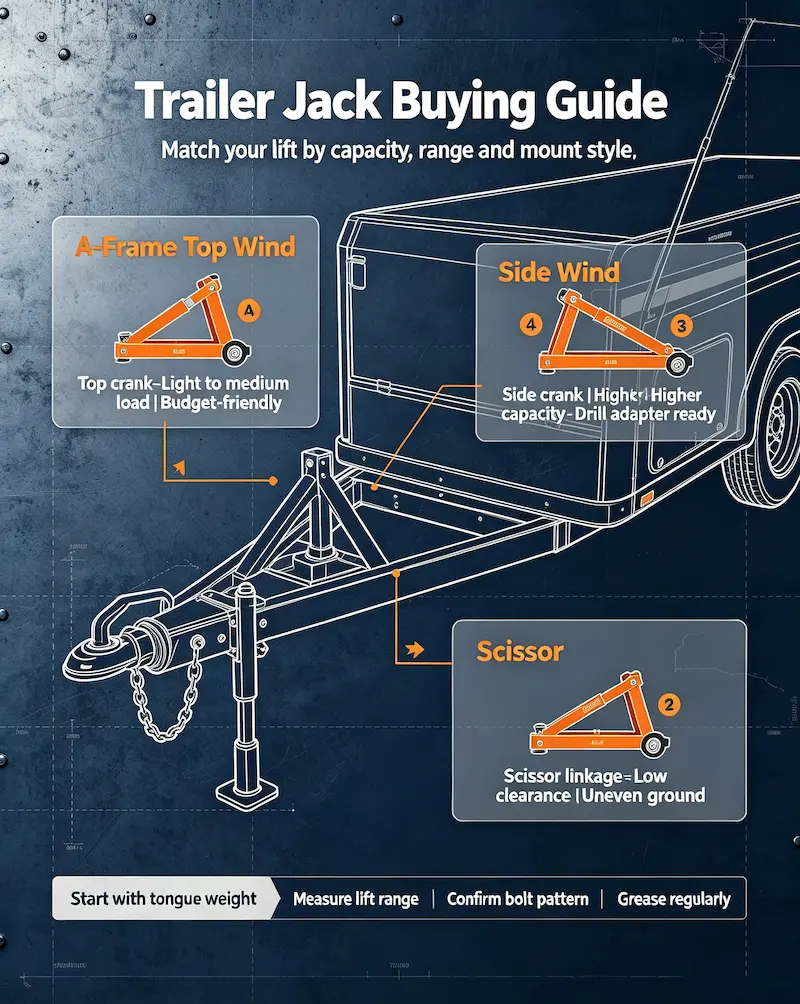
Every trailer owner knows the moment: you back under the coupler, lower the jack, and the trailer settles onto the hitch ball. That small mechanical workhorse does more than hold up the tongue — it sets the tone for every hookup, storage session, and maintenance day. Yet most buyers pick a trailer jack by price alone, and they pay for that shortcut with stripped gears, sagging couplers, and frustrating cranking.
Weifang Top Trailer Accessories has manufactured trailer jacks and other towing components since 2015, exporting to the United States, Canada, Australia, and New Zealand. In this trailer jack buying guide, we break down the three dominant designs — A-frame, side wind, and scissor — so you can match the lift to your rig.
The Three Main Types of Trailer Jacks
1. A-Frame Trailer Jack (Top Wind)
The A-frame trailer jack mounts directly to the A-frame tongue at the front of the trailer. You crank the handle from the top, and the threaded shaft drives the leg down to the ground.
Pros:
- Simple design with fewer moving parts
- Budget-friendly and easy to replace
- Reliable for light and medium trailers
Cons:
- The top-mounted crank sits high and can feel awkward on tall tongues
- You need clearance above the coupler to swing the handle
- Limited capacity options compared with side wind designs
Best for: small utility trailers, boat trailers, and lightweight caravans.
2. Side Wind Trailer Jack
A side wind trailer jack moves the crank to the side of the housing and routes the drive through a gearbox. This design lets you crank at a comfortable height without leaning over the tongue.
Pros:
- Easier cranking position, especially on heavy rigs
- Many models accept a drill adapter for fast raising and lowering
- Higher capacity ratings for larger trailers
- Cleaner access near the coupler
Cons:
- More internal gears mean more components to maintain
- Slightly higher price than a basic top wind unit
Best for: tandem-axle trailers, caravans, and anyone who raises the tongue often.
3. Scissor Trailer Jack
The scissor trailer jack uses a folding X-shaped linkage. When retracted, the whole unit collapses to a low profile; when you crank, the linkage extends and lifts the trailer.
Pros:
- Long lift range from a compact retracted height
- Excellent for uneven ground with a swivel foot
- Strong mechanical advantage during lifting
Cons:
- More joints and pivots to keep lubricated
- Slower cranking through the full travel
- Can sway under heavy side loads if you skip the foot
Best for: low-slung trailers, leveling tasks, and storage situations with tight clearance.
Side-by-Side Comparison
| Feature | A-Frame (Top Wind) | Side Wind | Scissor |
|---|---|---|---|
| Crank position | Top | Side | Side |
| Typical capacity | 1,000–2,500 lb | 1,500–5,000 lb | 1,000–3,000 lb |
| Lift mechanism | Threaded shaft | Threaded shaft + gears | Folding linkage |
| Best for | Light trailers | Heavy trailers, frequent use | Tight clearance, uneven ground |
| Maintenance | Low | Moderate | Moderate to high |
| Price | Lowest | Mid | Mid |
Table values are typical ranges; always check the specific rating printed on your unit.
How to Choose the Right Trailer Jack
1. Measure Tongue Weight First
Tongue weight decides everything. A good rule of thumb says tongue weight should sit around 10–15% of the trailer’s gross weight. You can measure it with a tongue scale or a bathroom scale and a pipe. Then pick a trailer jack rated at or above that number — never below. When in doubt, size up.
2. Check the Lift Range
Note the retracted height and the extended height. The retracted height must clear the ground while you tow; the extended height must reach high enough to lift the coupler over the hitch ball. Measure both on your trailer before ordering.
3. Match the Mounting Style
Some jacks bolt to the A-frame tongue, while others use a side-mount bracket or a swivel base that swings up for travel. Confirm the bolt pattern and bracket style against your trailer frame.
4. Choose the Crank and Foot
A drill-compatible side wind jack saves real time if you hitch and unhitch often. A swivel foot spreads the load and steadies the jack on soft or uneven ground.
5. Inspect Materials and Finish
Galvanized or powder-coated units resist rust far better than bare steel, especially for boat trailers and coastal use. Check the welds, the shaft, and the gear housing for quality before you commit.
Safety Rules That Apply to Every Trailer Jack
- Always chock the wheels before you raise or lower the trailer.
- Never exceed the rated capacity printed on the jack.
- Keep the ground surface firm and level.
- Look for components that meet recognized standards such as SAE J684, which covers couplings, hitches, and safety chains.
- Grease the shaft and gears regularly and retract the leg for storage.
How the Jack Fits Into Your Whole Rig
The tongue load your trailer jack carries connects directly to the rest of the running gear. If you raise the tongue too far or load the front unevenly, you shift weight away from the axles and change the handling profile of the entire trailer. That is why we recommend reading our guide on trailer axle load capacity and GAWR before you finalize any setup.
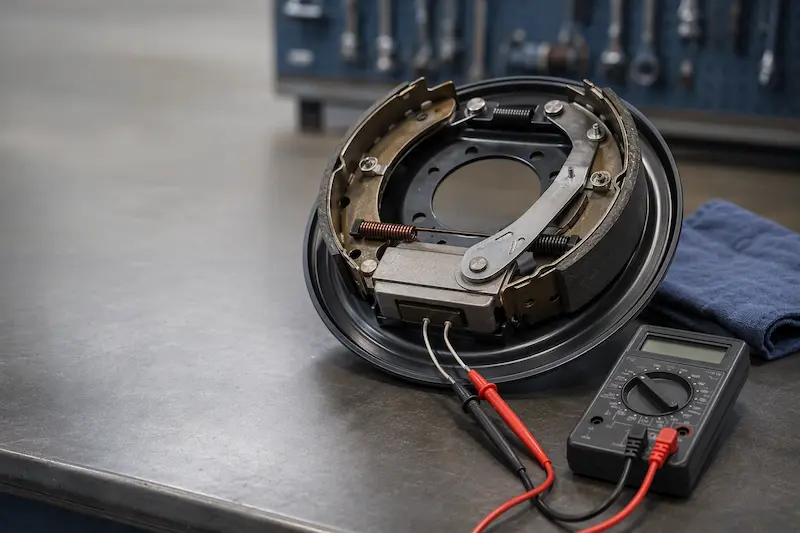
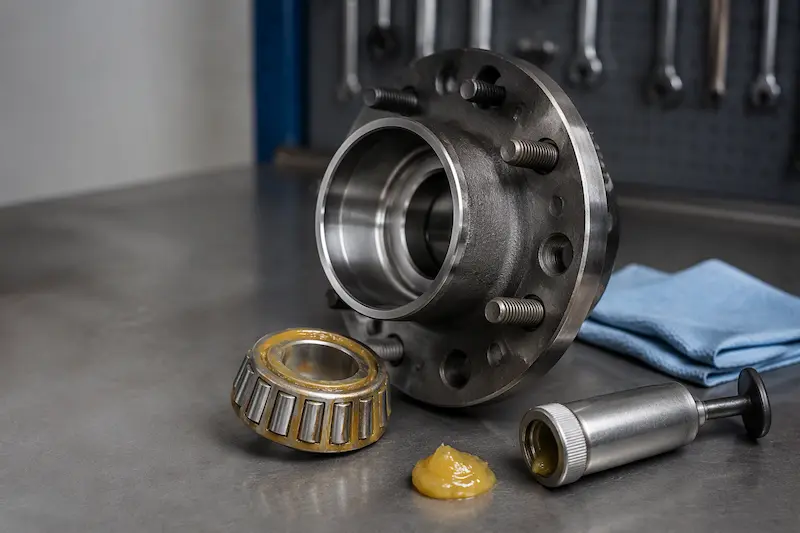
Meanwhile, a jockey wheel pairs with the jack for manual movement, while the trailer axle parts — spindles, hubs, bearings, and seals — keep the wheels rolling smoothly once you hitch up. And do not forget the braking side: a heavy trailer without a matched brake assembly becomes a hazard on long descents.
Browse the full range of trailer jacks and jockey wheels from Weifang Top, or compare aftermarket options on etrailer’s jack catalog to see how different designs behave in the field.
FAQ
1. What is the difference between a trailer jack and a jockey wheel? A trailer jack uses a leg and foot to support the tongue and lift the coupler. A jockey wheel uses a small wheel instead, so you can roll and steer the trailer by hand while you maneuver it. Many trailers use both: the jockey wheel for positioning and a jack for solid lifting.
2. How do I know what capacity trailer jack I need? Measure your tongue weight — usually 10–15% of the gross trailer weight — and choose a jack rated at or above that figure. Sizing up by one step costs little and adds a wide safety margin.
3. Can I use a drill with a side wind trailer jack? Yes. Most side wind models accept a socket adapter or hex drive, so a cordless drill can raise and lower the jack quickly. Check the product manual for the correct adapter size.
4. Which trailer jack is best for uneven ground? A scissor jack with a swivel foot handles uneven ground best because the foot stays flat and the linkage adjusts through a long travel. A side wind jack with a swivel foot also works well on moderate slopes.
5. How often should I maintain my trailer jack? Grease the shaft and gears every few months or after heavy use, tighten any loose bolts, and keep the leg retracted and dry when you store the trailer. Corrosion and grit cause most premature failures.
6. Can I mount a side wind jack on an A-frame tongue? In most cases, yes. Side wind jacks use the same bolt pattern as top wind units, and the offset crank simply changes where you stand while you work. Confirm the mounting bracket dimensions against your tongue before purchase.
Conclusion
The right trailer jack makes every hookup smooth, safe, and quick. A-frame units suit light trailers and simple budgets; side wind models shine on heavier rigs with frequent use; scissor jacks handle tight clearance and uneven ground. Match the capacity to your measured tongue weight, check the lift range against your coupler height, and maintain the unit so it serves you for years.
If you need help selecting a trailer jack for your build, contact the Weifang Top team — they supply OEM and ODM trailer jacks and related components to markets worldwide. Get in touch with your trailer specs and let the engineers recommend a lift that fits.