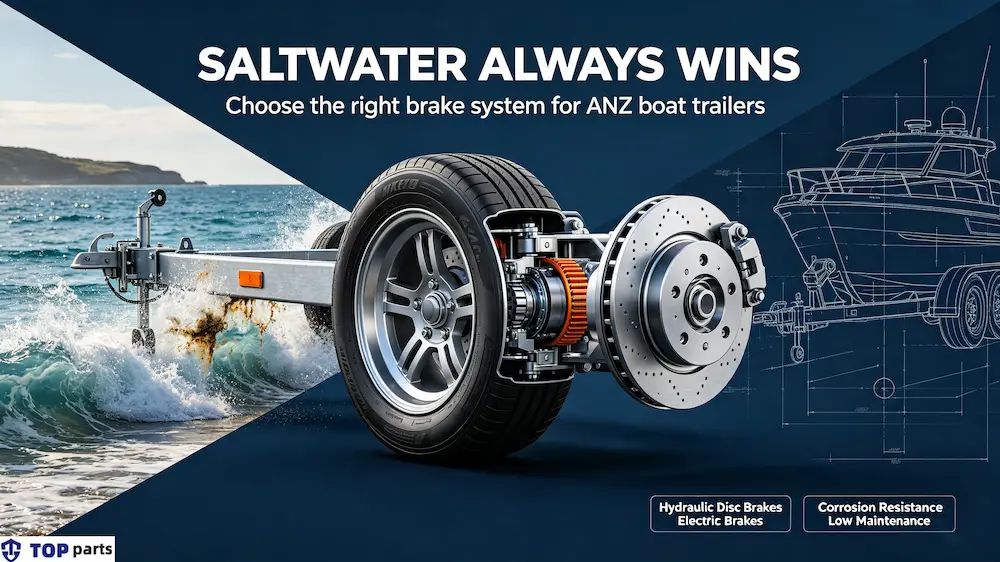
In Australia and New Zealand, boating is not just a hobby—it is a way of life. From the rugged coastlines of Western Australia to the pristine bays of the Bay of Islands, thousands of boat trailers roll into saltwater every single day. The question is not if your trailer brakes will encounter saltwater, but how long they will survive the encounter.
For ANZ boat owners, the choice between hydraulic and electric trailer brakes is ultimately a decision about corrosion resistance versus mechanical simplicity. At Top Axles, we supply both systems to customers across Australasia and understand the specific demands of the marine environment. Here is the technical comparison that will help you choose the right brake system for your boat trailer.
1. The Saltwater Problem: Why Boat Trailers Are Different
Conventional brake systems are designed to function in air. Standard trailers are never submerged entirely in water. But boat trailers are.
Galvanic Corrosion: Since saltwater is a great electrolyte, combining different metals like steel backing plates and aluminum actuator housings in saltwater will set up a galvanic cell. This will make aluminum corrode even faster.
Salt Crystal Abrasion: After boat trailer brakes have been submerged and salt water evaporates, salt leaves a thin layer of crystallized, abrasive material. Every time saltabraded brake shoes are used, the salt crystals will abrade the braking surfaces.
Moisture Trapping: Boat trailer brakes can be considered a sealed unit. Once the salt enters the drum of a boat trailer brake, it will take a long time to fully evaporate. During that time, saltwater will be corroding the metal surfaces and will continue to be corrosive on the next trip.
2. Electric Brakes in Saltwater: The Vulnerability Points
Electric trailer brakes are popular in the general trailer market because of their straightforward design and compatibility with most modern brake controllers. However, the marine environment exposes specific weaknesses.
Critical Corrosion Points in Electric Brakes:
-
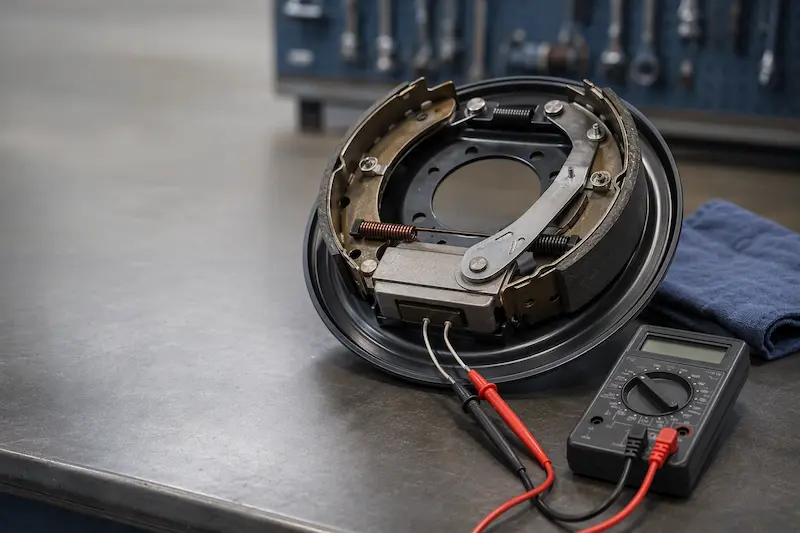
The Electromagnet: The magnet face is precision-ground and must maintain flat contact with the drum armature. Saltwater corrosion pitts this surface, reducing clamping force and causing uneven braking. A corroded magnet draws inconsistent current, potentially confusing the brake controller.
-
Internal Wiring and Short Circuits: The magnet coil windings are encased in epoxy, but repeated thermal cycling in saltwater conditions can create microscopic cracks. Once saltwater penetrates the coil housing, internal short circuits develop—causing either no braking or unpredictable lock-up.
-
Backing Plate Hardware: The return springs, adjuster cables, and anchor pins on standard electric brake assemblies are typically made from spring steel. Without specialized plating, these components begin rusting within weeks of saltwater exposure.
The ANZ Reality:
Many Australian and New Zealand boat owners who run electric brakes report replacing magnets and spring kits every 12 to 18 months. The cost of components is not the primary issue—it is the repeated labor of disassembling, cleaning, and rebuilding brake assemblies after every summer season.
3. Hydraulic Brakes in Saltwater: Engineered for Immersion
Hydraulic surge brakes—particularly disc brake systems—dominate the marine trailer market in Australia and New Zealand for good reason. Their design inherently handles immersion better than electric systems.
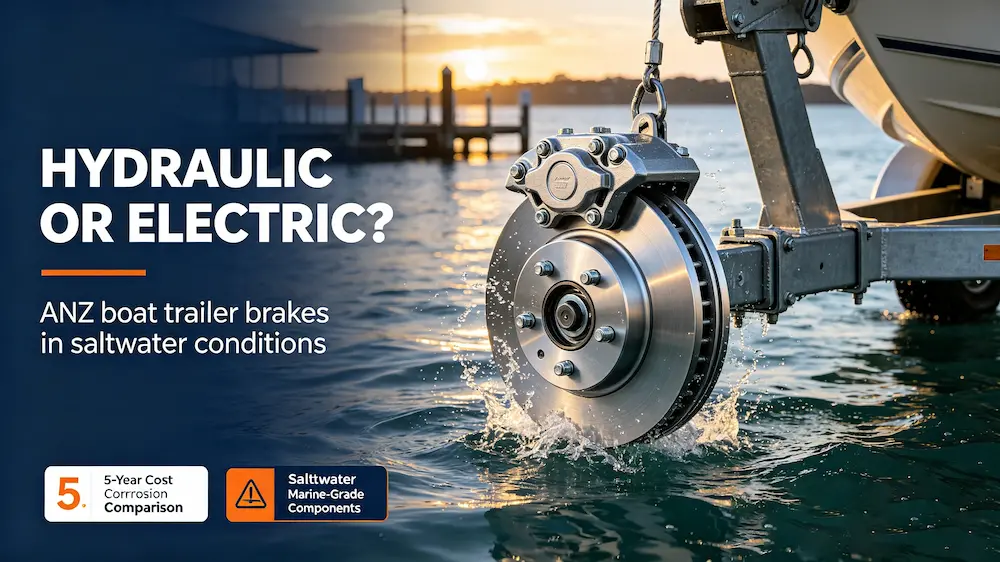
Why Hydraulic Brakes Resist Saltwater Corrosion Better:
-
No Electrical Components in the Hub: Hydraulic brakes eliminate the electromagnet entirely. The braking force is generated by a surge actuator on the trailer tongue that compresses a master cylinder, pushing brake fluid through stainless steel lines to the calipers. There are no wires, no coils, and no electrical connections anywhere near the saltwater.
-
Open Design of Disc Brakes: Unlike enclosed drum brakes, disc brake calipers and rotors are fully exposed. When the trailer is pulled out of the water, the spinning rotor flings water off almost instantly. There are no cavities where saltwater can pool and fester.
-
Stainless Steel Options: High-end marine hydraulic systems use stainless steel caliper pistons, stainless braided brake lines, and Dacromet-coated rotors. At Top Axles, we offer galvanized and corrosion-resistant brake components specifically treated for marine environments.
-
Surge Actuator Isolation: The surge actuator—the only moving mechanical component—sits mounted on the trailer tongue, well above the waterline during normal launch and retrieval. A sealed master cylinder protects the coupler even if water reaches it.
4. Maintenance Cost Comparison: 5-Year Ownership in ANZ Conditions
Based on typical Australian and New Zealand coastal usage (approximately 40 launches per year), here is the comparative maintenance outlook:
The data is clear: while hydraulic disc brakes cost more upfront, their total cost of ownership over a 5-year period is substantially lower in saltwater environments. For further marine maintenance guidance, resources like Boating New Zealand and the Marine Safety Agency (AMSA) publish regular updates on trailer safety standards and best practices.
5. Galvanized Components: The Third Option
For boat owners who prefer the simplicity of electric brakes but want improved corrosion resistance, galvanized brake assemblies offer a middle ground. These feature zinc-plated backing plates, stainless steel hardware, and sealed wiring connectors.
At Top Axles, we supply galvanized electric brake backing plates and hardware kits that significantly extend service life in marine applications. However, it is important to note: galvanizing protects the steel, but it does not protect the electromagnet internals from moisture ingress. The magnet remains the weak link in any electric system exposed to saltwater.
6. Decision Framework for ANZ Boat Owners
Choose Electric Brakes If:
- You launch in freshwater lakes or rivers more than 80% of the time.
- Your boat and trailer combination is under 2,000 kg ATM (Aggregate Trailer Mass).
- You already own a brake controller in your tow vehicle and want to avoid installing a surge actuator.
- You are willing to perform a thorough freshwater flush of the brake assemblies after every saltwater launch.
Choose Hydraulic Disc Brakes If:
- You launch in saltwater more than 50% of the time.
- Your rig exceeds 2,000 kg ATM—where Australian Design Rules (ADR) and NZ Transport Agency standards require more reliable braking.
- You prioritize low maintenance and maximum time on the water.
- You store your trailer outdoors near the coast, where salt-laden air accelerates corrosion even when not submerged.
Conclusion: Saltwater Always Wins—But You Can Choose How Fast
No brake system is immune to saltwater corrosion. The question is which system degrades more slowly and costs less to maintain. For the typical Australian and New Zealand boat owner who launches in saltwater dozens of times per year, hydraulic disc brakes deliver superior longevity, lower long-term maintenance costs, and greater peace of mind at the boat ramp. For freshwater-only applications, a quality electric brake system with galvanized components remains a cost-effective and reliable choice.
At Top Axles, we support ANZ boat trailer builders and owners with purpose-engineered brake solutions designed to withstand the unique demands of marine environments. Whether you choose hydraulic or electric, our components are built to keep you launching and retrieving safely, season after season.
Protect your trailer from the salt. View our Marine-Grade Brake Solutions or Contact our Team for ANZ-specific product recommendations.
FAQ
Q1: Can I simply rinse my electric brakes with fresh water after every saltwater launch to prevent corrosion?
Freshwater rinsing helps—but it is not a complete solution. While a thorough flush removes surface salt, water inevitably remains trapped inside the drum cavity, around the magnet assembly, and within the spring coils. The drum’s enclosed design means it dries slowly, giving corrosion hours or even days to attack steel surfaces. Rinsing extends component life but does not eliminate the need for regular magnet and spring replacement. If you launch in saltwater frequently, the maintenance burden remains significantly higher than with a hydraulic disc system.
Q2: Do hydraulic disc brakes work when the trailer is submerged?
Yes. Hydraulic surge disc brakes function perfectly underwater. The braking force is generated mechanically at the trailer tongue—when the tow vehicle slows down, the trailer’s momentum compresses the surge actuator, which pressurizes the brake fluid. There are no electrical components at the wheel end that can short out. The rotors and calipers operate submerged just as they do on dry land, which is why hydraulic disc systems are the standard for marine trailers worldwide.
Q3: What is the Australian Design Rule (ADR) requirement for boat trailer brakes?
Under Australian Design Rules, any trailer with an Aggregate Trailer Mass (ATM) exceeding 750 kg must be fitted with brakes on all wheels. For boat trailers over 2,000 kg ATM, a breakaway system is also mandatory—meaning the brakes must activate automatically if the trailer separates from the tow vehicle. Hydraulic systems with an electric-over-hydraulic (EOH) actuator are increasingly popular for heavier rigs because they combine saltwater-resistant calipers with a breakaway-compatible electronic controller. Always verify your specific setup against the latest ADR requirements published by the Department of Infrastructure, Transport, Regional Development and Communications.
Q4: Are there galvanized electric brake options that can handle saltwater?
Galvanized backing plates and stainless steel hardware kits—both available through Top Axles’ marine-grade product line—significantly improve corrosion resistance on the structural components of an electric brake assembly. However, the electromagnet itself remains the vulnerable component. Galvanizing the backing plate does not protect the internal magnet coil windings from moisture ingress. Galvanized electric brakes are a sensible upgrade for freshwater boaters or those who launch in saltwater only a few times per year, but they are not a substitute for a full hydraulic system in heavy saltwater use.
Q5: How often should I flush and bleed my hydraulic brake fluid?
Boat trailer hydraulic brake fluid should be flushed and replaced every two years at minimum. Brake fluid is hygroscopic—it absorbs moisture from the air over time. In a marine environment where humidity is consistently high, moisture contamination accelerates. Water in the brake fluid lowers its boiling point, which can cause brake fade on long downhill grades, and promotes internal corrosion in the master cylinder and caliper bores. For trailers launched in saltwater more than 30 times per year, annual fluid replacement is recommended.
Q6: What should I do if my electric brakes lock up after a saltwater launch?
Locked brakes after saltwater immersion are typically caused by rust-seized components inside the drum. Follow this diagnostic sequence:
- Attempt to rock the trailer forward and backward gently—sometimes the shoes will break free.
- If locked solid, remove the brake drum and inspect the magnet face for corrosion pitting and the return springs for breakage.
- Check that the adjuster screw is not seized. Apply high-temperature brake grease to the threads.
- If the magnet shows deep grooves or visible coil windings, replace it immediately.
For detailed troubleshooting steps, refer to our companion guide: “Why Are My Trailer Brakes Locking Up? Common Causes and Fixes.”
Q7: Which system do Australian and New Zealand boat trailer manufacturers prefer?
The overwhelming majority of OEM boat trailer builders in Australia and New Zealand specify hydraulic disc brakes for saltwater-rated trailers. Brands like Dunbier, Mackay, and Voyager equip their marine trailers with surge-actuated or electric-over-hydraulic disc systems as standard. This reflects decades of real-world experience in ANZ coastal conditions, where the lower maintenance burden and superior corrosion resistance of hydraulic systems have proven their value over electric alternatives.