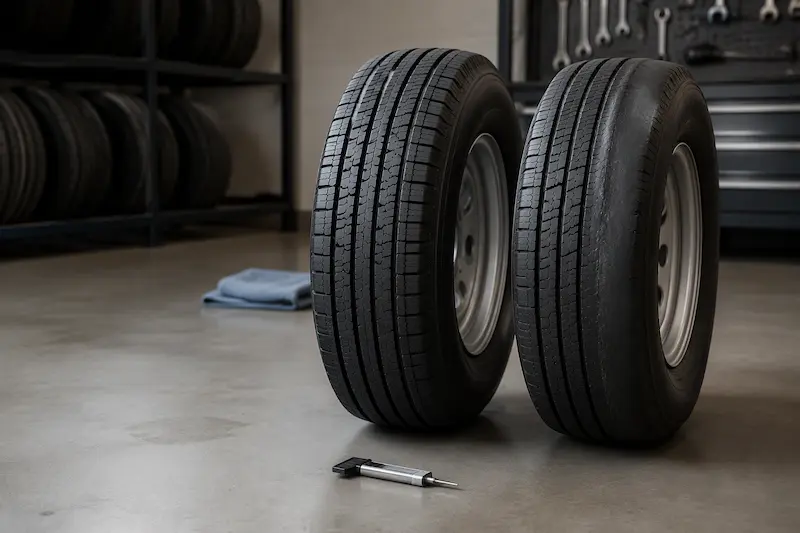
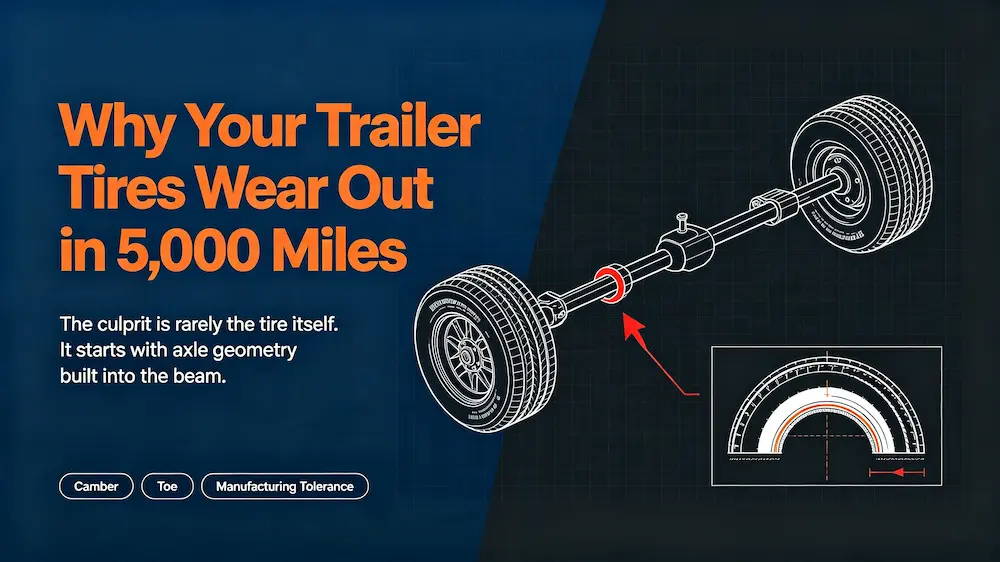
Most trailer owners accept tire replacement as a routine expense. But when a $150 trailer tire wears down to the cords in 5,000 miles while the identical tire on the opposite side looks nearly new, something is fundamentally wrong. The culprit is almost never the tire itself—it is the axle camber geometry programmed into the beam at the moment of manufacture.
At Top Axles, our engineering team works within micron-level tolerances to ensure every axle delivers the correct camber and toe specifications. But to appreciate why these tolerances matter, you must first understand what these two angles do under real-world load conditions.
1. What Is Axle Camber?
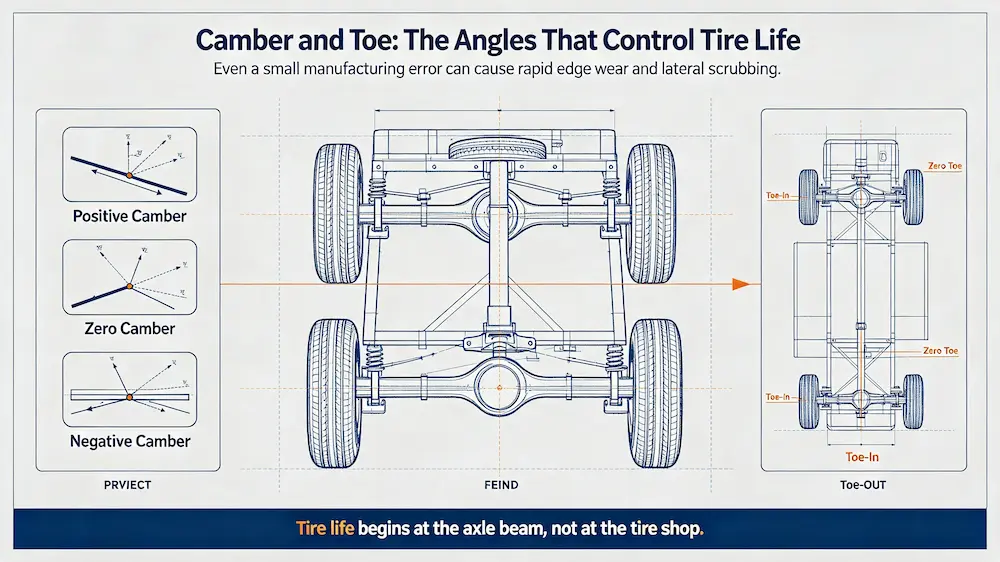
Camber is the inward or outward tilt of the wheel when viewed from the front or rear of the trailer.
- Positive Camber: The top of the tire leans outward, away from the trailer frame.
- Negative Camber: The top of the tire leans inward, toward the trailer frame.
- Zero Camber: The tire sits perfectly perpendicular to the road surface.
For most straight trailer axles, the manufacturer intentionally builds positive camber into the axle beam—a subtle upward bow in the center of the axle tube. This is not a defect. It is an engineered feature.
2. The Positive Camber Paradox: Why a “Bent” Axle Extends Tire Life
The logic feels counterintuitive. Why would you manufacture an axle that is deliberately not straight?
The answer lies in elastic deformation under load. When a trailer axle is at rest and unloaded, the positive camber pushes the tops of the tires outward, concentrating wear on the outer tread edges. However, when the trailer is loaded to its rated capacity, the axle beam flexes downward—and that positive camber angle decreases, ideally reaching near-zero degrees at the rated Gross Axle Weight Rating (GAWR).
The result: Under actual operating conditions—the only condition that matters—the tires run flat and true against the pavement. This is why a properly manufactured axle wears tires evenly across the full tread width, even though it appears bowed when unloaded.
What Happens When Camber Is Wrong?
3. What Is Axle Toe?
Toe describes whether the front of the tires point inward or outward when viewed from above.
- Toe-In: The front edges of the tires are closer together than the rear edges.
- Toe-Out: The front edges are farther apart than the rear edges.
- Zero Toe: The tires are perfectly parallel to the trailer’s centerline.
Unlike camber—which is designed into the axle—zero toe is the target for nearly all straight trailer axles. Any deviation forces the tires to scrub sideways against the pavement with every rotation.
4. Toe Misalignment: The Tire Life Killer
A toe error of just 1/8 inch (3.2 mm) across the tire diameter is equivalent to dragging each tire sideways approximately 28 feet for every mile traveled. Over 10,000 miles, that translates to more than 50 miles of pure lateral scrubbing—grinding the tread blocks into an angled, “feathered” wear pattern.
How Toe Error Occurs
- Manufacturing Defect: If the spindle is welded onto the axle tube at an incorrect angle, the toe is permanently wrong. This is why precision jig welding and post-weld inspection are non-negotiable quality control steps in modern axle production.
- Axle Shift: Hard impacts (potholes, curbs) can shift the axle’s position on the leaf springs. Even if the axle itself has perfect toe, a shifted axle runs crooked relative to the frame.
- Frame Misalignment: The trailer frame itself may be out of square, causing both axles to track at an angle even with perfectly manufactured components.
5. Manufacturing Tolerances: What “Precision” Actually Means
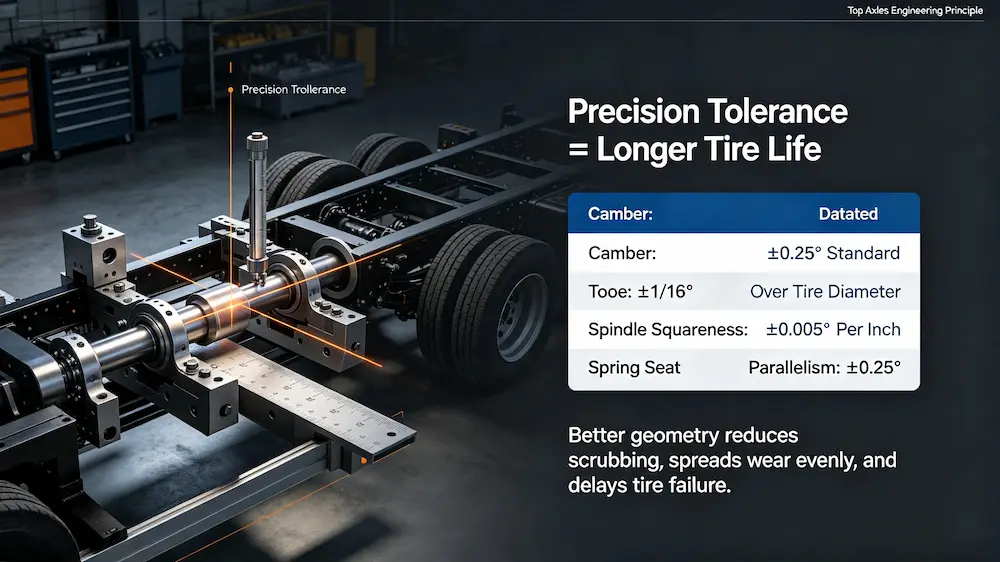
At Top Axles, our manufacturing process controls both camber and toe to strict tolerances that directly impact tire longevity:
These tolerances are verified through our quality control process using calibrated fixtures and precision measurement equipment, ensuring every axle that leaves our facility meets the specifications our customers depend on.
6. How to Verify Your Axle’s Geometry in the Field
You do not need a laser alignment rack to perform a basic axle camber check. Here is a practical method:
Camber Check (Loaded Trailer)
- Load the trailer to its typical operating weight.
- Park on a verified level surface.
- Place a carpenter’s level vertically against the tire sidewall (or use a digital angle finder).
- Measure the angle from vertical. A reading between 0° and 0.25° positive is acceptable. Any reading over 0.5° or any negative reading indicates a problem.
Toe Check (String Method)
- Stretch a string line along each side of the trailer, secured to jack stands at axle height.
- Measure the distance from the string to the front and rear edges of each tire (at hub center height).
- The difference between front and rear measurements should be less than 1/16 inch (1.6 mm).
For a deeper dive into diagnosing and correcting alignment problems, refer to our companion guide: “The Importance of Axle Alignment: How to Save Your Tires and Fuel.” For industry alignment standards, the Society of Automotive Engineers (SAE) publishes technical papers on trailer axle dynamics and tire wear modeling.
7. When to Replace vs. When to Realign
-
Repositionable misalignment: If the axle has simply shifted on the spring seats—evidenced by clean metal exposed where the U-bolts used to sit—loosen and retorque after realignment. This is a suspension issue, not an axle defect.
-
Irreparable damage: If the spindle is bent relative to the axle tube (common after striking a curb at speed), the axle must be replaced. No amount of adjustment can correct a damaged spindle angle. Continuing to run on a bent spindle will destroy a new set of tires within a few thousand miles.
At Top Axles, we manufacture replacement axles with exact axle camber and toe specifications, ensuring a bolt-in solution that restores proper geometry. Our custom axle fabrication service allows you to specify spring centers, hub faces, and the precise axle camber angle that matches your operational load requirements.
Conclusion: Tire Life Begins at the Factory
The difference between getting 8,000 miles and 40,000 miles from a set of trailer tires is often determined before the axle is even installed—in the precision of the camber bend, the squareness of the spindle weld, and the flatness of the spring seats. By understanding these geometric principles, trailer owners can make informed purchasing decisions and catch alignment problems before they compromise safety.
At Top Axles, precision manufacturing is not an afterthought—it is the foundation of every axle we ship to customers across the United States, Canada, Australia, and New Zealand. Our engineering team takes pride in delivering axles that keep your tires running true, mile after mile.
Ready to eliminate premature tire wear? Contact our Engineering Team for a custom axle specification or Browse our full Axle and Component Range.