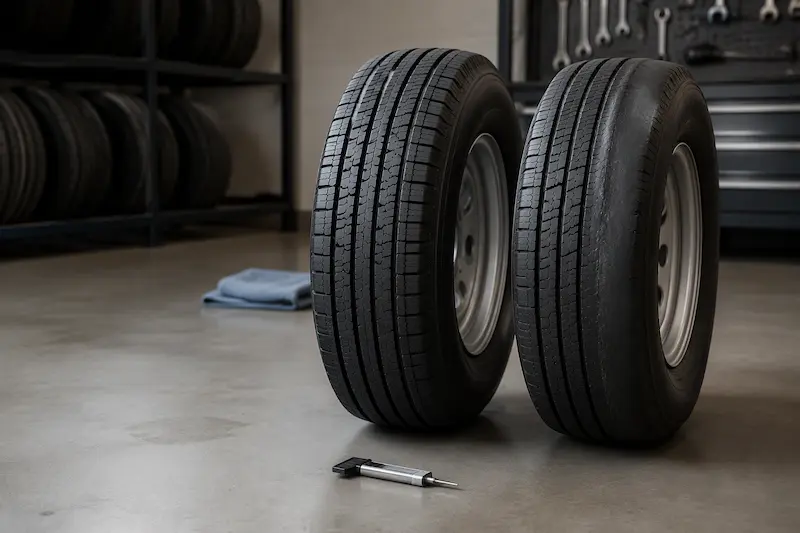
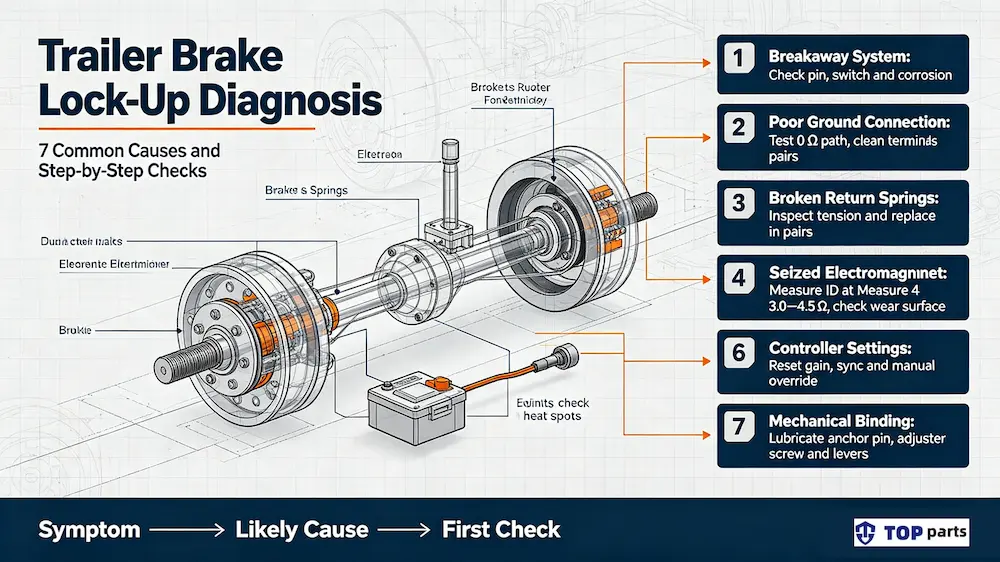
Few things are more frustrating—or dangerous—than trailer brakes that lock up unexpectedly. You are cruising down the highway when suddenly the trailer starts dragging, the tires begin smoking, and your fuel gauge drops visibly faster. Worse still, locked brakes can overheat to the point of igniting bearing grease or shredding a tire at highway speed.
Most brake lock-up scenarios are not random failures. They are the predictable result of specific component malfunctions that can be diagnosed with a logical, step-by-step approach. At Top Axles, we have helped customers worldwide troubleshoot these exact problems. Here is how to isolate the root cause and restore safe braking performance.
1. Start Simple: Check the Breakaway System
Before diving into complex diagnostics, rule out the most common oversight. Many trailer owners do not realize that a partially pulled breakaway pin will energize the brakes continuously, even when the tow vehicle is off.
How to check:
- Inspect the breakaway switch near the hitch coupler. If the plastic pin is missing, pulled halfway out, or corroded internally, the brakes may be receiving constant power.
- Reinsert a fresh breakaway pin fully. If the brakes release immediately, you have solved the problem in 30 seconds.
2. Poor Ground Connection: The Invisible Culprit
Electric trailer brakes operate on a “floating ground” principle—current flows through the brake magnet, into the backing plate, through the axle, and back to the tow vehicle via the trailer frame. If the ground path has high resistance, the brake controller may output excessive voltage trying to compensate, causing erratic or locked-up behavior.
How to diagnose:
- Check the white ground wire connection at the trailer plug and at every junction box. Look for corrosion, loose ring terminals, or paint interfering with metal-to-metal contact.
- Use a multimeter to measure resistance between the trailer frame and the tow vehicle’s battery negative terminal. It should read close to 0 Ω. Anything above 1 Ω indicates a grounding problem.
- A dedicated ground wire running directly from each electric brake assembly to the tow vehicle’s chassis is the most reliable fix.
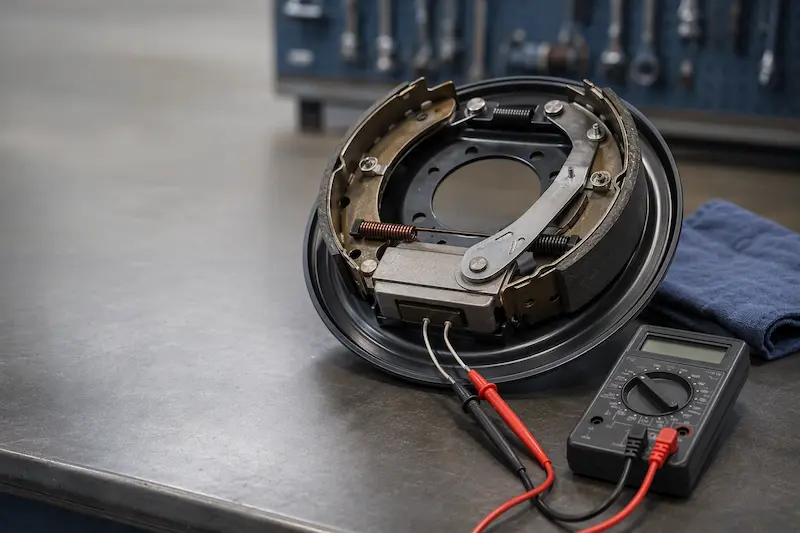
3. Broken or Weak Return Springs
Each electric brake assembly relies on heavy-duty return springs to retract the brake shoes away from the drum when power is released. If a return spring breaks, stretches, or rusts through, the affected shoe remains in contact with the drum—dragging or locking.
How to diagnose:
- Remove the brake drum and visually inspect all springs (primary return spring, secondary return spring, and adjuster spring).
- Look for: stretched coils with gaps between turns, rust pitting, broken hook ends, or a spring that appears “tilted” compared to its counterpart.
- A quick manual test: push the shoes outward by hand and release. They should snap back instantly and symmetrically. Any hesitation or binding points to spring failure.
How to fix: Replace all springs on both sides as a complete hardware kit. Mixing old and new springs creates uneven braking forces across the axle. Our brake component kits include OEM-grade springs matched to your specific backing plate model.
4. Damaged or Seized Electromagnet
The electromagnet is the heart of an electric brake system. When energized, it clamps onto the rotating brake drum face, and the friction pulls the actuating lever to spread the shoes. However, a failing magnet can cause two distinct lock-up scenarios:
Scenario A: The Magnet Won’t Release A warped or grooved magnet surface can “stick” to the drum armature even after power is removed. This is most common on magnets that have been run while severely worn—the uneven wear pattern creates mechanical interlocking.
Scenario B: Internal Short Circuit Moisture ingress can corrode the internal windings, creating a partial short. The controller cannot regulate current properly through a shorted magnet, leading to either no braking or full lock-up with no middle ground.
How to diagnose:
- Inspect the magnet face. A healthy magnet has a smooth, flat wear surface. Replace any magnet with deep grooves, uneven wear, or visible coil windings showing through.
- Measure the magnet’s resistance with a multimeter. Typical values: 3.0–3.5 Ω for a 10″ brake (1.5A draw); 4.0–4.5 Ω for a 12″ brake (2.0A draw). Significant deviation indicates internal damage.
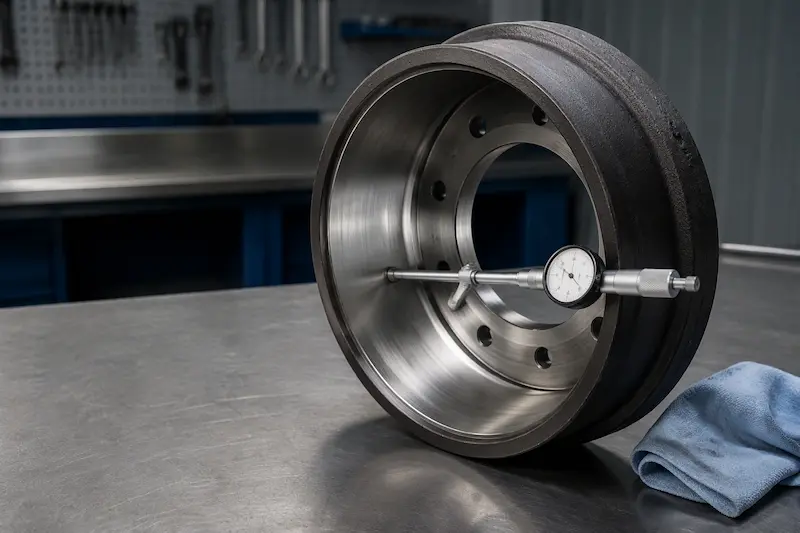
5. Brake Drum Out-of-Round (Ovality)
A brake drum that has worn into an oval shape creates a mechanical “pulse” with every rotation. In severe cases, the high spot on the drum catches the brake shoe at the same point in each revolution, mimicking a lock-up sensation or causing rhythmic dragging.
How to diagnose:
- Use a brake drum micrometer or an internal dial gauge to measure the drum’s inner diameter at four equally spaced points around the circumference.
- Out-of-round tolerance for a standard 10″ or 12″ trailer brake drum is typically 0.006″ (0.15 mm) or less. Exceeding this limit means the drum is no longer true.
- Also check for hard spots (blue/purple heat discoloration) which indicate localized hardening from overheating—these areas wear at different rates than the surrounding cast iron.
How to fix: A mildly out-of-round drum can be resurfaced on a brake lathe, provided it remains above the minimum thickness stamped on the drum edge. Severely oval or heat-damaged drums must be replaced. At Top Axles, we supply precision-cast brake drums machined to strict concentricity tolerances.
6. Incorrect Brake Controller Settings
Sometimes the problem is not the brakes themselves—it is the brain controlling them.
Common controller-related causes:
- Gain set too high: A time-delay controller with excessive gain will apply full braking voltage even during light pedal pressure, grabbing the trailer brakes.
- Incorrect sync setting: On proportional controllers, a misconfigured inertia sensor applies braking that is out of phase with the tow vehicle, causing delayed drag.
- Manual override stuck: Some controllers have a manual slide lever. If this lever is jammed or stuck in the “on” position, the trailer brakes receive continuous power.
How to fix: Reset your controller to factory defaults and perform a re-calibration drive. Refer to your controller manufacturer’s manual (Tekonsha, Curt, Reese) for the specific setup sequence.
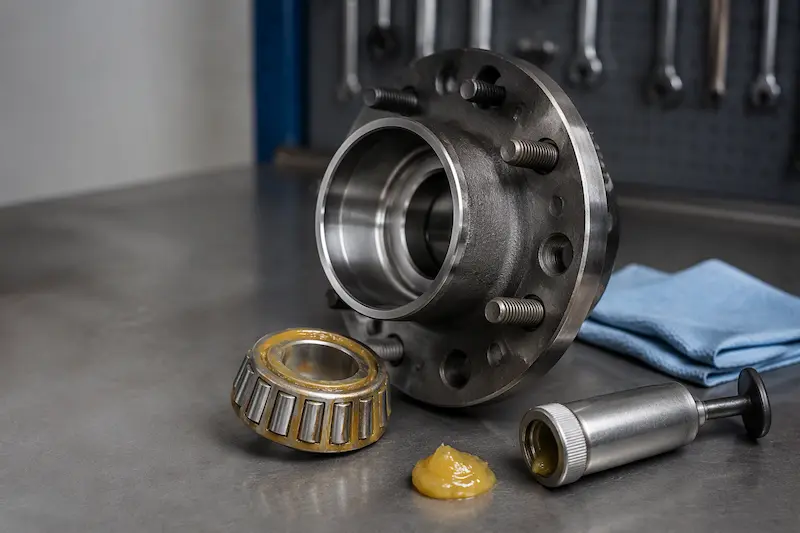
7. Mechanical Binding: Lubrication Points You Are Missing
Electric trailer brakes have several pivot points that require periodic lubrication. When these seize, the shoes cannot retract.
Key lubrication points:
- Anchor pin (where the shoes pivot)
- Adjuster screw threads
- Actuator lever pivot
- Magnet arm pivot
Use a high-temperature brake grease sparingly—apply only to metal-to-metal contact points, never on the friction surface of the shoes or drum.
Diagnostic Flowchart Summary
| Symptom | Most Likely Cause | First Check |
|---|---|---|
| Both brakes lock simultaneously | Controller / Ground / Breakaway | Check breakaway pin and ground resistance |
| One brake locks intermittently | Return spring / Binding | Remove drum, inspect springs and pivots |
| Rhythmic grabbing (pulse) | Out-of-round drum | Measure drum ID at 4 points |
| Lock-up after water crossing | Short in magnet windings | Measure magnet resistance |
| Brakes drag but do not fully release | Magnet sticking / Spring weak | Inspect magnet face for grooves |
Conclusion: Systematic Diagnosis Saves Time and Money
Locked-up trailer brakes are almost never a “mystery failure.” By working through the diagnostic chain—from the simple breakaway pin to the more involved drum measurement—you can isolate the culprit in under an hour and avoid throwing money at unnecessary parts replacements.
At Top Axles, we manufacture and supply the complete range of electric brake assemblies, brake drums, and replacement hardware kits that keep your trailer stopping safely and predictably. For additional technical guidance on trailer brake systems, the National Association of Trailer Manufacturers (NATM) provides industry-standard maintenance resources.
Still chasing a brake gremlin? Contact our Technical Support Team for personalized diagnostics or Browse our Full Brake Component Catalog.