
Understanding the legal requirements for trailer brakes in Australia is essential for compliance, safety, and peace of mind. The rules are consistent across states and territories and are based on the trailer’s weight rating. This guide provides a clear breakdown of your obligations for trailers up to 4,500 kg Aggregate Trailer Mass (ATM).
Understanding GTM vs. ATM
Before diving into the requirements, it’s crucial to understand the two key weight terms:
-
Gross Trailer Mass (GTM): The total mass transmitted to the ground by the trailer’s wheels when it is coupled to a towing vehicle and carrying its maximum load. It does not include any weight imposed on the towing vehicle through the tow coupling.
-
Aggregate Trailer Mass (ATM): The maximum allowable total mass of the trailer, including any load and the weight imposed on the tow vehicle’s coupling.
Engineers or assessors normally evaluate compliance and brake requirements against the trailer’s GTM or ATM rating shown on its compliance plate or in the manufacturer’s documentation.
Brake Requirements by Weight
The minimum braking equipment required for a trailer is determined by its GTM. The following table is derived from the National Code of Practice for Building Small Trailers (Vehicle Standards Bulletin 1, or VSB1):
| Gross Trailer Mass (GTM) | Minimum Braking Equipment Required |
|---|---|
| 0 – 750 kg | No brakes required. |
| 751 – 2,000 kg | Brakes operating on at least one axle. Over-run (surge) braking systems are permitted. |
| 2,001 – 4,500 kg | Brakes operating on all wheels. Over-run brakes are not permitted. A breakaway/emergency braking system is mandatory. |
Key Requirements for the 2,001 – 4,500 kg Range
For heavier trailers in the 2,001 – 4,500 kg GTM category, more stringent regulations apply:
-
Brakes on All Wheels: The braking system must operate on every wheel of the trailer.
-
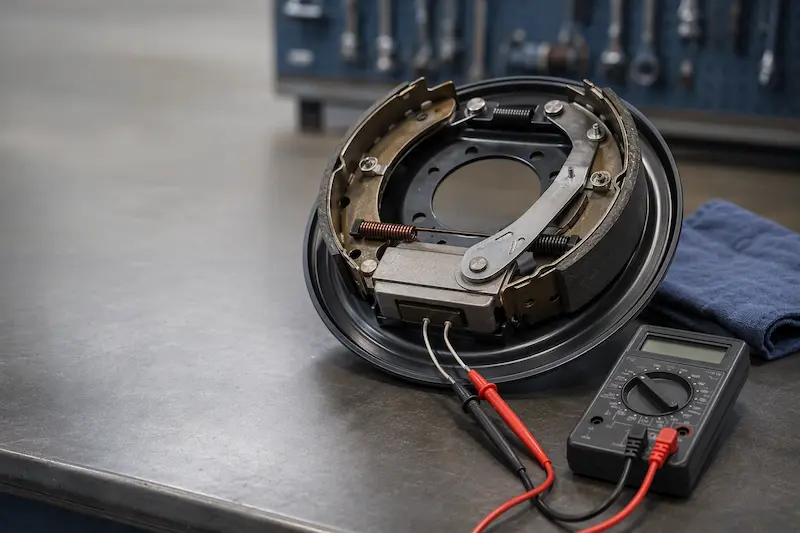
Prohibition of Over-run Brakes: Over-run (surge) braking systems are not permitted. The brakes must be activated by a control signal from the towing vehicle. This typically means electric or electric-hydraulic brakes.
-
Breakaway System: An automatic breakaway or emergency braking system is required. This system must activate the trailer’s brakes if it becomes detached from the towing vehicle.
-
15-Minute Hold Requirement: The breakaway system must be capable of applying and holding the brakes for at least 15 minutes following a detachment.
Regulatory Basis and Compliance
These requirements originate from the Australian Design Rules (ADR), specifically ADR 38/05 – Trailer Brake Systems, which specifies the performance and installation requirements for trailer brakes. VSB1 provides a practical interpretation of these rules for light trailers.
States and territories administer these national rules through their own registration and inspection processes, so it is always wise to confirm specific requirements with the local registering authority.

Quick Compliance Checklist
Use this checklist to verify your trailer meets the legal requirements:
-
Verify the Trailer’s GTM: Check the compliance plate for the trailer’s GTM or ATM rating.
-
0–750 kg: No brakes required.
-
751–2,000 kg: Ensure brakes are fitted and operational on at least one axle. Over-run brakes are acceptable.
-
2,001–4,500 kg:
-
Verify brakes are operational on all wheels.
-
Confirm that the braking system is not an over-run type and is activated by a signal from the tow vehicle.
-
Ensure that a breakaway system is fitted and that its battery/mechanism is in good working order to hold the brakes for 15 minutes.
-